Friday, 26 December 2025

Dive in Wonderland: With Alice in Wonderland will release in Europe in 2026


A new year treat for European carrollians!

Feature length anime inspired by Lewis Carroll's timeless novels. In-crisis university student Rise (Nanoka Hara) tumbles into Wonderland and meets Alice (Maika Pugh) The two have curious adventures in a whimsical, nonsensical world.  

P.A Works's Anime for Alice160, Alice in Wonderland: Dive in Wonderland, will release in France, Belgium, Luxembourg, Switzerland and Poland on the 14th of January, and elsewhere in Europe very soon.

 Distributors ADN Anime have confirmed territories for future release are: Spain, Netherlands, and Germany. You can read their press release (in French) here. 

There is unfortunately no English language country release on the horizon as of yet, and as always there will be an update to this post if that changes.


Saturday, 29 November 2025

Alice160... happened


(Charlotte Bradley as Alice and Daniel Page as the Queen of Hearts in Penny Farrow's Alice in Wonderland, London UK cast. Image by Steve Gregson)

As we're coming towards the end of Alice160, the 160th anniversary of the publication of the first Alice book, Alice's adventures in Wonderland, its worth reflecting on what this anniversary has meant and what events took place. I really do wonder what cultural studies scholars (such as Will Brooker) will make of this anniversary. Unlike 1932 or 1997, it is not a birth-year centenary for Dodgson. Like 2015, it is an anniversary of the first Alice novel's publication, except this year lacked major projects for the most part. Its worth thinking, first and foremost, on what an anniversary's purpose is. We might say to re-engage the general public on why a work of art exists and why it matters. With long dead artists like Dodgson, anniversaries help to keep the work relevant. In that regard, I think we can say that Alice160 has mostly worked, even if there are big gaps with mainstream projects this year just not really popping up. 

I'm going to focus on the UK the most here, since I know this place the best. If you as an international reader had a different or better Alice160 experience, I do hope you enjoyed it!

In the UK, the year has been dominated by smaller celebrations, often with a community focus. You can see this with the wool based character installations in Rugby, and a wealth of community theatre productions, normally of Duffield's adaptation, Wade's modern adaptation, or La Gaillenne's adaptation of almost everything.

(Aside: Adrian Mitchell's 2 part version (also known as the RSC/Royal Shakespeare Company Alice) is still criminally underseen in theatres, despite being the best script on the market. I maintain it does both books better than La Gaillenne's does. I strongly recommend theatres go for Mitchell when considering a version of Alice to produce.)  

The big theatre project this year was Penny Farrow's sell out musical Alice coming to London with a new UK cast (it had premiered in Sydney a few years ago). I didn't get to see this, and unfortunately I don't think it has a published script so I can't review it. However it got rave reviews in the press, with many saying that it had same whimsy and spirit as the novels. There was no brand new big theatre creation like for 150, where we had Wonder.land from National Theatre. Several new works have popped up for the festive season, although at the moment no one knows if Geoff Aymer's modern Peckham set adaptation or Chinonyerem Odimba's play will go the distance, or even if those two will be published or get good reviews. We'll see!

The biggest new bit of information academically we had this year was the collection donated to Oxford University, something I hope will get a catalogue book or digitalised listings. 

Film/TV this year was sadly mostly an off year. There are 2 Alice160 projects, but you'll likely see them next year. The P.A works anime Dive in Wonderland, with dual Alice characters, and the Russian/Estonian musical Alisa v Strane Chrudes. Both, oddly enough, have had very mixed reviews in regions that have had first release. Dive has been criticised for being too random and Alisa has been criticised for not adhering enough to the audio musical its adapting. Time will tell if these critiques are relevant for worldwide viewers of these works. 

I noticed the most in the UK, that events around Alice160 were almost always to do with the novels, or adaptations of them. This is fantastic, but the keen eyed among you may have noticed something. Apart from small things here and there, minimal mention of Lewis Carroll/Charles Dodgson himself! Unfortunately the biographical elements were mostly missing from this anniversary year. Culturally the UK seems somewhat keen to capitalise on Alice160, but very much not keen to talk about Charles Dodgson.

After 25 years of post myth research (Leach, Woolf, ect) I have to wonder why!

Sunday, 23 November 2025

Cursed Alice found media: late night aired Channel 4 version


(Hetty Baynes as Alice and other actors at the tea party scene, in the TV special's first half. Image credit: IMDB)

This is a difficult one to talk about, sorry if I make any errors on the background. If you know more about this than me, its fine!

Channel 4 and Ken Russell (yes the UK director provocateur, you can see where this is going already) made in 1995 a version of Alice that for reasons unknown, relays the history of the Soviet Union/USSR, with particular focus on Russia. Channel 4 gave Russell the money out of the documentary side of the budget, so yes this does count as that. It doesn't feel like it for various reasons (I'll explain in a bit) but its technically a history documentary. The piece was called "Alice in Russialand" and it aired on late night channel 4, I believe airing twice in 1995 and 1996. It then vanished for decades, and finally turned up on lost media Reddit, someone finding it through a VHS tape from Brazilian 1990s TV, where it also appears to have aired, late night on an arts channel.

What is this version like? Despite NOT being extreme as Russell's other work (he was working to Channel 4 broadcast rules after all) it still manages to be eyebrow raising and rather alarming in terms of tone in many places. If you thought the Svankmajer 1988 version was creepy, goodness.

It doesn't start this way, though. It starts in a fairly normal satire genre place, somewhat similar to Pla's 1976 Argentinian version or 1988 Svankmajer, using political figures as stand ins for Wonderland characters. The atmosphere however feels off. As if there is something wrong with the tone of the work. You can see it in how Hetty Baynes acts as Alice. So sincere that she crosses over to creepy. She looks like Tenniel's illustration, except her smile is far too wide and she's far too detached from everything she comes across. Baynes plays this role perfectly. You will have chills.

7 year old Alice really just wants to see a ballet, but unfortunately for her, she's stuck in a history lesson which goes through 200 years of Russian/USSR history all the way up to 1995. You think this might upset her, an unwanted difficult, long history lesson when all she wants is to see theatre, but because of how off this version is, Baynes's Alice barely cares. Her journey in hour one is also a very quick Alice in Wonderland adaptation, going from doors all the way up to trial fairly faithfully. This part of the special is done like a Victorian style stage play, with elaborate and fairly beautiful sets. The most part of the special has a storybook vibe, despite the satire, until it doesn't. Remember this is absolutely not for children. Remember who the director is... 

Remember how off I said the entire special felt? This comes bursting to the forefront when Alice wakes up under a tree... and meets the cheshire cat. Immediately we're thrown off course. As every Carrollian knows, the cheshire cat comes FAR before, after the Duchess. What is he doing here? He's here to tell Alice he's from Chornobyl, and there, everyone died. The Cat seems to find this hilarious. Alice has to follow him, he apparently knows more information.

Now cat wants to show Alice and us, some clips about the USSR. Some of these are archival clips, some are cultural, some are artistic, and some I wonder if Russell just made up himself. The way the compilations of clips are organised are to be as jarring as possible. Some feature overlays upon overlays and dissonant sound. Again I think some of this may be edited by Russell. I couldn't find it confirmed. At some point, your jaw will be on the floor just due to the amount of clips and noise and distortion. As Alice sees 1995 new year across Europe, she finally wakes up...

Oh wait. She doesn't (again). No er.. Alice's reality with her sister is revealed to be just part of a massive book set. Those elaborate book sets from hour one were a part of it. There is no riverbank reality.  Baynes's Alice can't go home. She can never go home.

Sneaks up on you, doesn't it?

I'm not sure who I'd recommend this to. It is very much a curio. History scholars would find it interesting. Europe scholars would too, also film historians. People who like Russell's work would like this. Even though its intended as a documentary, the abrupt shifts in tone and the fact you are never sure where you sit with it, that's more psychological horror. I'm sure a normal documentary could have been done, but its the left turn halfway through this that you'll really remember.

Saturday, 20 September 2025

Now also on Substack!

 This blog will now be cross-posted with Substack, so if you miss any posts on here, do look for them on there! Substack might in future have exclusive posts just for that, I've not decided yet.

Saturday, 6 September 2025

Alice160: Reading Alice's adventures in Wonderland, in French, for the first time


(Photo source: Le boncoin, Magnard/Classiques et Patrimoine Alice au pays des Merveilles, schools edition. I highly recommend this edition for B1/B2 french learners. The footnotes make it way easier)

NOTE: Since much of this post is about reading the Alice novels for the first time or in a new language, it might interest you to know that the North American Lewis Carroll Society offers free readings of the novels to US schools. You can donate to this project here (Choose the Memorial fund option)

My first ever encounter, aged 7, with Carroll's novels (then Wonderland, I didn't read Looking-Glass until I was about 9 or 10) was with a dictionary in one hand, and the book in the other. I remember the dictionary was heavy, it was one of those that my family had sellotaped to stop it from pulling apart MANY times. I had to look up a lot of words on that first reading. No 7 year old alive in the last 2 centuries would know what a "bathing-machine" was, nor a "quadrille" unless they were very into dance. Despite the hard words, it didn't matter. I can't quite remember what my feelings on first reading were, except that this 100 + year old book somehow spoke to me in the way at the time 2000s era children's fiction could, only really half do.


(Charles Dodgson (Lewis Carroll) 's original vision of Alice and the croquet game, illustrated in
Alice's adventures Underground manuscript)

In Wonderland, no adult or animal makes sense, Alice is (at least a first time reader who doesn't know the ending reads) alone with no help. She must rely on her own intelligence and her own perceptions. The things she is taught by other people, school, authority: lessons, poems, don't work in a chaotic world that is upside down. Alice is strong willed, and, for the most part, isn't really afraid of anything that gets thrown at her. Sure, Alice's adventures aren't real in narrative, they are a long, strange, asleep-for -too-long dream. The idea is one any reader can relate to, since we've all likely had at least one memorable one in our lives. Alice herself is brilliantly eccentric. Carroll informs us, Alice in the real world loves to pretend to be two people, views her cats as her best friends and equal to people, and maybe even scares the people around her a little. Its this that makes her such a fascinating and brilliant character, and somehow film and TV versions often fail to capture this part of Alice's personality. 


This summer, as part of my French learning attempts, I read Alice's adventures in Wonderland for the first time in another language. It was partly like going back to being 7 again. Lots of words I didn't know. Here a whole tense (Passé Simple) that was partly new to me. The translation I read was the very first one into French, from 1869, by Henri Bué. With footnotes for some words, of course. Bué's translation is for the most part very faithful to Carroll's text, except that its wonderfully french-ified. Alice attempts to speak Italian to the mouse, recites "monsieur corbeau" (mister crow, a fontaine fable, based on the crow and the fox) wrongly, and the Hatter recites a distortion of "ah vous dirai-je" a famous french Victorian nursery rhyme, with the exact same tune as Twinkle Twinkle Little Star. Little things here and there transplant the story not to Victorian England Oxford but to somewhere in the France French campagne (countryside) and this works brilliantly. 

There are, I'm sure, jokes I missed in Bué's translation, as an early B1 french learner, I'm almost certain. Then again, I missed quite a few jokes on my first reading of Wonderland in English aged 7/8, and that didn't stop me. 


I think sometimes when carrollians worry that children or teenagers will never pick up Carroll's books, and will never enjoy them "now". That publishers must produce abridged editions even for children who are old enough to read the two classics (I don't think age 7/8 is too young an age, even if all jokes aren't understood) We forget how some children will always be drawn to these stories naturally, including all the Victorian words that they don't understand. Folio Junior in France (in an edition I don't have) has footnotes, and a explanation of the author and characters and their world at the back after the novel itself ends. Puffin Classics in the UK do similar but somehow don't have footnotes for some words (why is this?) But, if a child connects with the novels, trust me, they won't really care about what a few words are, and might just look things up just to know. For some people, reading Carroll just fits their personality, or is a way of reading about dreams, or gives them a way of understanding a bizarre, complex world (which the adult world very much is, Carroll knew this as much as anyone) 

I think despite all the complex readings (and sometimes total mis-readings) us adults have given Carroll's two little books, to forget that they were intended for the enjoyment of the 3 Liddell sisters (all under 14 at the time of hearing these tales) is to deny ourselves of both these stories true meaning: fun, and things to read that aren't lessons. Any child can relate and will always relate to that.

Friday, 4 July 2025

4th of July!


(Above: the boating party listen to the story of Alice,  Alice in Wonderland (1986 BBC) Dir: Barry Letts)

Today officially marks so called "Alice's day" (Or at least, that's what Oxford calls it now) when, in 1862, Charles Dodgson/Lewis Carroll started to tell the Alice stories to the Liddell sisters and Robinson Duckworth on Oxford boating trips. This by Karoline Leach:

Summer of  1862.  Charles Dodgson  is telling the ‘Alice’  story to the three famous sisters, Ina, Alice and Edith Liddell,  while  on their famous river-trips.  Indications are the girls  loved  the tale and were always begging for new instalments, but that Dodgson was less enthusiastic (on one occasion he calls  it the ‘interminable’ Alice’s Adventures, and is peeved because he wants to sing them a new song he just made up instead). At around the same time Alice asks him to write her story down. He promises he will do so.

 Whilst the actual writing of the story would take Dodgson over 6 months to start, the germ of what would become Alice's adventures Underground and, world famous as Alice's adventures in Wonderland, indeed started on these boating trips between friends, the story's episodic structure reflects this, as do the in jokes made for the 4 listeners of the tale. Even if Dodgson was less enamoured with having to continually come back to the Alice story and add extra episodes. The world is forever glad he did! 

(Above: The Three Liddell sisters, 1864, Lorina (seated) Alice (right) and Edith (left) captured in the artwork The Sisters by Sir William Blake Richmond)

Today's recommendation is Alice in Wonderland (1986 BBC) which begins at this very first storytelling boating trip, on the 4th of July. Kate Dorning plays a dual role in this version. She plays both a quiet Alice Liddell, and a delighfully eccentric, wild Alice. For once the two look different, perhaps reflecting that Dodgson never saw his fictional creation as actually being Alice Liddell herself!

Of course Alice160 celebrations will be all year round this year, but the epicentre, as always, is Oxford. Alice's day celebrations are tomorrow there.  If you can't make it, there's a whole list of events worldwide that I've curated here, including at home options. For reading recommendations, I VERY much recommend Macmillan's complete Alice for English language readers, and Jenny Woolf's biography the Mystery of Lewis Carroll (originally published 2010) which is available in English and Japanese editions.

Whichever way you decide to celebrate, have a wonderful July 4th, and July!

Saturday, 3 May 2025

Alice160: New Carrollianism in Film/TV


This post is part 1 of 2 discussing Alice160, and its cultural relevance, as well as future relevance. This part examines cinema and upcoming/new visions of Alice in Cinema. Part 2 will discuss legacy of Carroll, current legacy, and possible ways to increase engagement.

This is a post I've wanted to write for a while after seeing quite a lot of new Alice films pop up at film festivals and elsewhere relatively recently :)

After an obliterating 20 year gap of adaptations of Alice in Wonderland and Through the Looking-Glass, outside of the 2010 films which didn't adapt the books, and TV specials of filmed theatre, cinema and TV finally heralded a new interest in 2020/2021 with Carroll's works. All directed by independent filmmakers, this new group of films we can include:  Daniel Leite Almeida 's Alice in Backlands, Giulia Grandinetti's Alice and the Land that Wonders, Fabrício Bittar's Alice in the Internet, and Adam Donen's Alice Through the Looking

 Releases specifically upcoming for this year of Alice160 will be Toshiya Shinohara and PA Works's anime Dive in Wonderland.

These films are all disparate, appealing to different audiences, and demographics, and using Carroll's texts for  different ends. Sometimes these films have shades of politics, sometimes they put 2020s lifestyle under a microscope by using carroll's work as a lens, but always they are startlingly original. Not every project from this list is out commercially yet (and some were seen for a limited time) but this short list shores up interest by screenwriters and directors in Carroll's work for the first time in a long while.

Because the 1999 TV film got such a mixed critical reaction upon airing, and related to this, the 2016 in name only attempt by Disney getting such a disastrous reception, it is noticeable that many "new" alices from the above list make a point aesthetically and artistically by choosing the opposite choices to Disney's 2010 duology or 1999's spectacle. Spectacle in big budget visual effects, big ticket million dollar actors, and CGI landscapes. None of the new films since 2020 place Alice and her dreamworlds in a Victorian setting either, Backlands opts for the landscape and community of the Northeastern Brazil outback, Internet opts for the internet, Land that Wonders reconfigures its Wonderland as a cold health clinic and Looking throws its student Alice into an alternate satirical London. 

In the question for how to make 2020s audiences connect to Alice, her dreamworlds, and the mysterious characters that populate it, this new film trend opts to go as modern and therefore as understandable to audiences as possible. Gone are the poems, the remarks about bathing machines, mock turtle soup, victorian railway journeys and teatimes. Whilst it is a shame to see some of these elements from Carroll disappear in new adaptations, the non success of the last versions that tried a Victorian setting is an obvious reason as to why this choice is no longer taken. If audiences do not connect with the Victorian setting, filmmakers' revisioning the novels to now remains the only viable option to connect the Alice tales back to cinema audiences and to invite new ones in.

I invite you to watch the trailers of these "new carrollian" films below. Some you can find around online, others are awaiting release. All are worth your time:

(TW: some trailers contain strobe lighting)


Friday, 28 March 2025

Alice 160 events list!


(Source: Official Alice160 Japanese logo by MacmillanAliceJP)

Scroll all, all the way down to the very bottom of this blog to find a list of events that will be updated monthly as Alice160 starts to roll out celebrations, performances, TV broadcasts, film screenings and much more. Exclusives, world premieres, and rarities will be highlighted amongst many other things.

The calendar contains contributions by the good people of Lewis Carroll Society Facebook, and is made possible by Elfsight. 

Sunday, 16 February 2025

Alice 160: "Viens nous voir Alix!" - Alix and the Wonderfolk (2019 -21) and carrollian language learning.


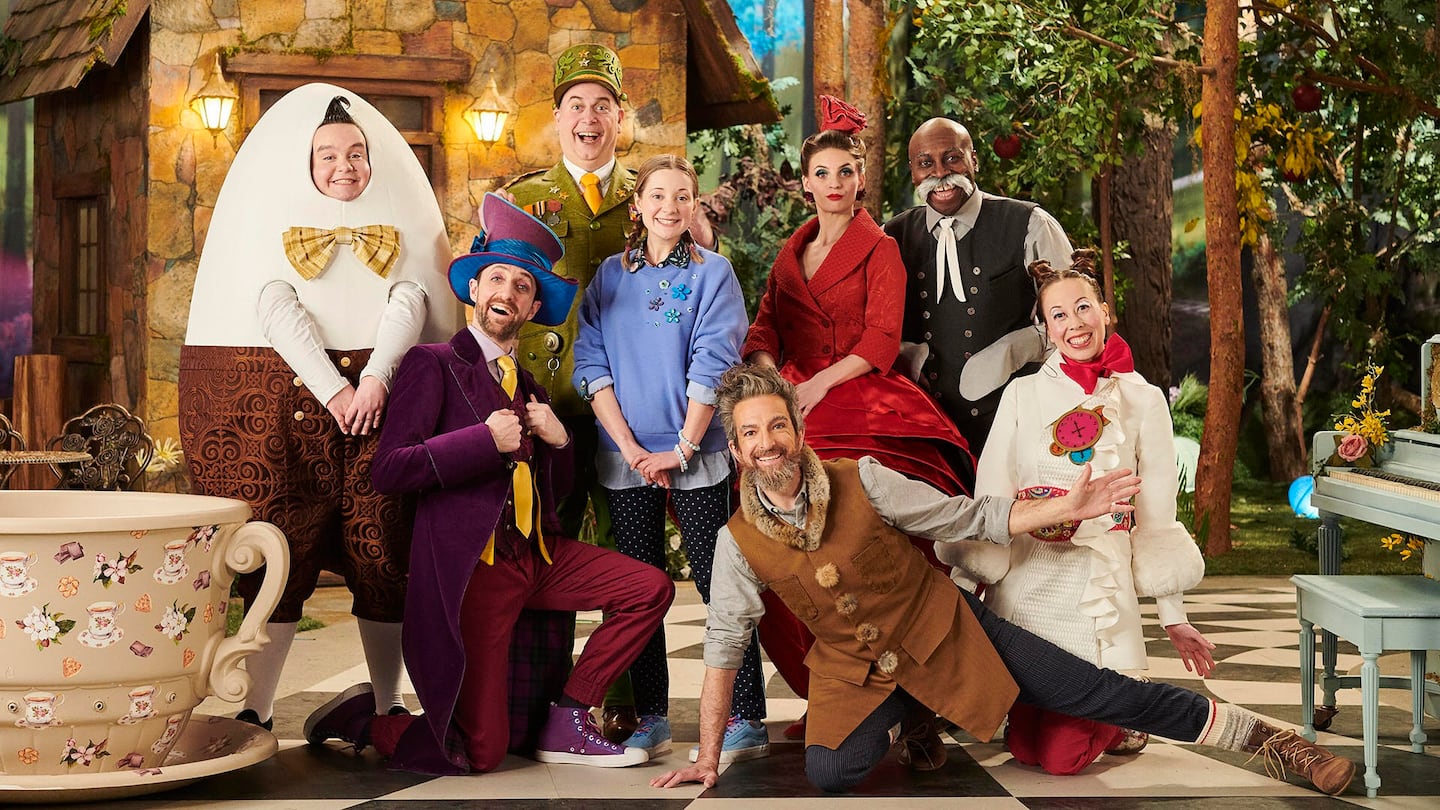
(All the major characters. Credit: ici.tou.tv

7 year old Alix walks through her mirror into a magical land. She befriends the wise walrus, inventive Hatter and Hare, and energetic egg Gros Coco. Their adventures are hindered by the overbearing queen like boss supreme director. (IMDB description

Regular viewers of the French conglomerate tv Channel TV5MONDE in Europe may have noticed things have gotten rather Carrollian in the mornings. As part of its Jeunesse (Children's/Youth) programming TV5MONDE Europe have started showing season 2 of the French Canadian series "Alix et les Merveilleux" (Alix and the Wonderfolk) This little half an hour series ran on Canadian TV for 3 years.  This series could well gain a audience of language learners, and Carrollians, beyond the intended child target market. I'll explain in a moment why I think if you're learning French (any variant, but especially French as spoken in Canada) this show will really help. First we'll talk about what this series actually is!


(Alix (Rosalie Daoust) and Rabbit (Inès Talbi) Photo Credit: TV5MONDE)

Although not an adaptation of the famous novels, Alix... has a end credit which translates to "liberally inspired by the work of Lewis Carroll" and certainly it makes good on that promise. The spirit of Carroll's original books is retained here by how bizarre the plotlines per episode get. There will be turns that logically make no sense, or are designed to make the audience laugh. In several episodes Alix breaks from daydreaming to ask her family a question related to her dream, which on answering, she dives back to imagining again. 

In this sense Alix holds on to the intent of Carroll's work the way other children's series using the characters normally don't. It remembers to be as strange as a literal dream, as well as amusing.  Plots generally start with Alix facing a problem in real life, typically with her parents, sister, or brother (all double as roles in Wonderland later) then daydreaming she goes through a mirror under the stairs and encounters friends who are having similar problems in a parallel plot. Yes, it has the same set-up as Adventures in Wonderland (1992) and long term fans of that can consider this series a direct successor. I prefer this series personally just for more how carrollian it feels and how off the rails plots can go.


(The Pause tea party. Photo Credit: TV5MONDE)

Rosalie Daoust's Alix, energetic, helpful, and a daydreamer,  is Alice in modern-day childhood, whilst Grande Patronne (Marilyn Castonguay) with selfish demands, royalty status, and want to send someone to the dungeon, mirrors the Queen of Hearts. Rabbit (played by Inès Talbi) mixes the White Rabbit with White Knight characters, having Rabbit's overall characteristics but knight's inventing flair (like Knight, the inventions always go catastrophically wrong one way or another) Chef (Martin Héroux) is a mix of Caterpillar, King of Hearts and the footmen characters, being a messenger for royalty, and loving rules and order. Morse (as played by Didier Lucien) is a strange mix of the looking glass sheep (he runs a shop with a magical counter) and the Walrus (giving his love of raw fish) Humpty Dumpty (played by Alex Desmarais) re-named Gros Coco, is a young egg, and often overexcited, and perhaps the character here who is the furthest from their original form. Hatter and Hare ( Jean-Philippe Lehoux and Luc Bourgeois) are as usual, but Hare is a musician who has anxiety, and this Hatter actually owns a hat workshop.  The "mad tea party" is a enforced tea break that occurs once per ep where characters are obligated to drop what they are doing in the plot, take tea together, and play a childhood game, or just one that is plain weird. 

Carrollian objects and themes such as: cards, strange versions of croquet, chess, nonsensical trials, weird kitchen running, songs that make no sense, dancing, ridiculous advice, bad advice, logic-less laws, seeing dreams as important, and magical foods all make their due appearances in the series. Not bad at all for something that is nominally an "inspired by" work. There is an unshakable sense that the writing team has read Carroll's novels over several times, and has tried to re-create the same feelings of fun, whimsy, and outright strangeness in their own work. I can't really say this for any other series which also fall into the "character and location using" category.


(Alix (Rosalie Daoust) encounters Chef (Martin Héroux) (Photo credit: TV5MONDE)

So why may Alix as a series help Carrollians who specifically are learning French? First of all, the series is already has characters you'll know, albeit in a different form. Secondly, it has a jaw dropping 195 episodes, making it one of the longest "inspired by" Carroll series to run. Thirdly, the language, being for younger audiences, is somewhat simplified, meaning if you're a beginner/late beginner in French, this is for you. The accents of the actors also have a bonus of being for the most part, VERY clear. You can 100 percent learn from this series also if you aren't learning the French Canadian variation of French (just bear in mind some words are different in standard, as is prononciations). 

Lastly, its just fun. Fun is something that is difficult to replicate in language learning and if this series can be that for you, it will certainly help. 

Alix and the Wonderfolk airs on TV5MONDE Europe on weekdays. It is on demand worldwide at PLUS, and some episodes with French subtitles are on Archive.org. 

Thursday, 23 January 2025

Neil Gaiman betrayed us all

 A quick note about the horrific prolonged SA cases that have come out around Neil Gaiman. I have been reading his work since the age of 11. I knew 0 about his character aside from what he wrote in introductions, and wikipedia's then small background tab.

Gaiman preyed on fans, people like you, people like me. He was not who anyone thought he was. 

I have talked about Coraline (2002) as its original novel, animated film, opera, and stage versions. I can do so no longer. Whilst the posts will remain on this site I will pin to each the article by New York Magazine on Gaiman's crimes, which I will link underneath this post. 

I believe every victim who has come forward.

LINK: THE SIDE OF NEIL GAIMAN HIS FANS NEVER SAW, BY LAUREN STARKE (TRIGGER WARNINGS APPLY)


Thursday, 4 July 2024


All in the golden afternoon, full leisurely we glide... 
(Happy July 4th!)


On this day, July 4th, Charles Dodgson took his friend Robinson Duckworth, and the three Liddell sisters, Lorina, Edith and Alice, on the first of several boating trips. Over that summer the first incarnation of the tale of "Alice's adventures Underground" (now known to all as Alice's adventures in Wonderland) was told episodically in a stop start fashion by Dodgson. The tale was made up on the spot and subsequent parts incorperated jokes and things Duckworth and the Liddells would find funny or interesting. The story was written down much, much later and presented to Alice Liddell in November 1864.


More about the timeline of the book's creation can be read here (article by Karoline Leach) 

Monday, 13 May 2024

Notification!


 Alice in Backlands (original title: Alice Dos Anjos) is now on dailymotion with English subtitles!

Alice (Tiffanie Costa) discovers a bizarre and brilliant land where she encounters even stranger characters. However the community is under threat from a local colonel who will do anything to take the land the community relies on.

This delightful adaptation aired on ARTE1 Brazil a few months ago, after many years round festival circuits in the region. It has a cabinet of trophies to prove its worth now. For us here its most valued as being the technical first adaptation of Carroll's Alice books as a film/TV special since... 1999's NBC attempt. 

I'd say more, but really you should just go and enjoy it. This is the first of several adaptations this decade to release (if IMDB is correct fully) so we are nowhere done with Carroll and film yet :)

You can follow announcements for this film officially on instagram :)

Tuesday, 19 December 2023

Thoughts on Charles Dodgson/Lewis Carroll's unedited diaries (1993, edited by Edward Wakeling)


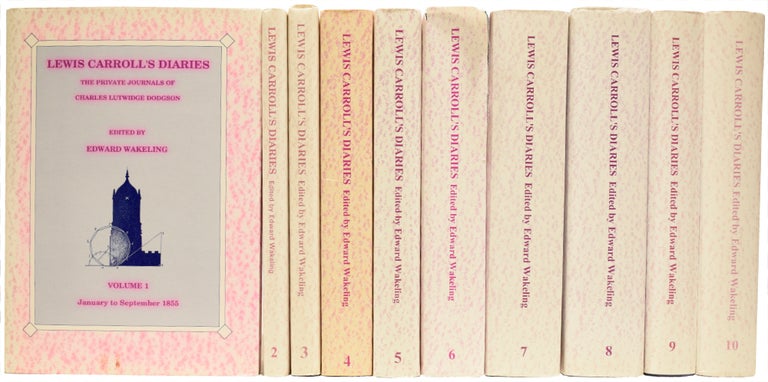
(A rare complete set of the undedited diaries, photo by Harrington Books UK)

A dear friend of mine is currently undertaking work in regards to Charles Dodgson/Lewis Carroll's unedited diaries. These are the ones that are most complete and were published in the mid 1990s by the Lewis Carroll Society UK, and edited with expert footnotes by Mr Edward Wakeling. I have now had the jaw dropping oppertunity to read 4 of these. I'll explain why I called this jaw dropping later in this piece, but for now, it is worth reflecting on Mr Wakeling's sheer skill at putting together these diaries as an actual series of books, and piecing together insights that were completely lost/not known in Green's 1950s version. 

Its impossible to talk about these diaries without talking about what got lost via other people's editing. Green's edited diaries of an early era, are of course, only half the story. Green omitted, according to Karoline Leach, 50 percent of the diaries. He was handed an edited manscript, edited for content. As documented by Hagues Laibally, Dodgson's own descendants would cut out anything they deemed too "adult" in nature for this children's author to be doing.

What they found much more difficult to cope with was the plentiful evidence [....] of C. L. Dodgson's attendance at and enjoyment of what they considered as coarse performances starring young pert actresses, as well as of the favourable impression various adult female nudes produced on him: proof of such vulgar tastes looked to them far more scandalous, and they suppressed it in a much more consistent and systematic way, unaware that they were thus reinforcing and confirming the already too widespread view of 'Lewis Carroll' as a monomaniac perverse. 

 So that's any references to romance with adult ladies, and any references to "erotic" art that Dodgson seems to have enjoyed. Laibally also notes that what was omitted was:

13 % of the books C. L. Dodgson read [32 out of 242]

20 % of the plays he witnessed [139 out of 683]

65 % of the concerts he heard [79 out of 121]

53 % of the light entertainments he attended [18 out of 34]

40 % of the exhibitions he visited [87 out of 215]

and 15 % of the individual sculptures and paintings he singled out [44 out of 293]

were omitted from the first printed version of his diary, together with 199 mentions of or

judgments passed on the impersonations of actors and actresses of all ages out of 870 [about 23%]

In Wakeling's restored 1993 diaries, we see:

  • Dodgson's art and culture reviews (doesn't like wuthering heights, does like the opera Norma)
  • Day to day life details at Christ Church
  • Dodgson's growing interest in photography and writing.
  • Dodgson's friends, many of whom are adults and often are left out of his story in popular culture.
  • Dodgson's attitudes to religion. Volume 4 includes multiple prayers that have long mystified scholars. Why do these prayers appear sporadically across this volume? No one really knows. Leach and Woolf point at a potential love affairs, each with varying theories. Others have rather disingeniously, tried to claim the prayers are about Alice Liddell, who features far less in these diaries than you'd imagine.

Wakeling's 1993 diaries restore a lot of what Green left out, or rather everything in 1993 that existed (minus the cut pages in diary document, which had not been found yet) Taking into context that 1990s era, its a remarkable achievement. Made even more impressive when, upon searching newspaper archives, I found almost nothing but wall to wall myth boosting about Lewis Carroll/Charles Dodgson in newspapers in the 1990s. The climate Mr Wakeling was working in appears to have been one that was media wise openly hostile to carrollians and had long sided with the now known-as-incorrect freudian stance. 

This may or may not explain why, inexplicably in my opinion, the press and popular culture as a whole did not react to the findings in the undedited diaries in 1993 or indeed, when the project finished. The supposed, even wanted, "confession" about Alice Liddell never appeared, because it never existed. That doesn't mean at all that these diaries were not "valuable", quite the opposite! Why no one did a piece on these in a public paper is beyond me.

Unfortunately, the only negative thing I can say regarding these diaries is that they are hard to get hold of.  This is why I said that my reading of them felt jawdropping to me. They are sold exclusively via the Lewis Carroll Society UK, and exist in full in US university libaries across America. The lack of access is a punishing blow for such important evergreen evidence. I wish I could encourage everyone who's interested in Carroll or has read his works to read these diaries too. And I wish the media could have read them.

SOURCES:

BOOKS:

Leach, Karoline. In the Shadow of the Dreamchild: the myth and Reality of Lewis Carroll, Peter Owen Press, 2015. 

Wakeling, Edward, Lewis Carroll's Diaries. The Private Journals of Charles Lutwidge Dodgson, Luton: Lewis Carroll Society, 1993-2007.

PAPERS

Through A Distorting Looking-Glass: Charles Lutwidge Dodgson's artistic interests as mirrored in his nieces' edited version of his diariesBy Hugues Lebailly. 

Tuesday, 19 September 2023

Rest in peace Edward Wakeling 🕯


(Edward Wakeling with manuscript replica of one of Charles Dodgson's diaries, photo via Keithpp, circa July 2010)

Devestated to hear of the passing of perhaps the only world expert in Lewis Carroll, Edward Wakeling. Wakeling's dedication to his subject matter unearthed many key documents and his lagacy shall hopefully be of someone who changed Carroll academia forever for the better. In later years Wakeling spoke out against misreadings of Carroll in the press and media and was not afraid to correct other biographers or read new research. His openess was rare in Carroll scholarship and he showed great integrity. 

He will be sorely missed.

Saturday, 13 May 2023

Softly vanishing away: A review of the Hunting of the Snark (2023)

 Based on: the Lewis Carroll poem of the same name

Directed and adapted by: Simon Davison

Staring: Ramon Tikaram (Narrator/the Baker) Ralph Arliss (The Bellman) Tim J. Henley (the Bonnet Maker) Tom Wansey (the Butcher) Peter Daw (the Banker) Tristam Kimbrough (the Billard Marker) Nick Mellersh (the Barrister) Jose Barreto (the Boots) Bernard Myers (the Broker) Richard Ecclestone (The Baker's Uncle) Corrinne Furman (Hope) 

This UK crowdfunded film, beautifully shot with Victorian style camera lens effects, has been quite a long time coming. Originally funded far before 2020, the filming process took several years and its premiere was delayed due to the pandemic. Snark is the first out of a bulk of Carroll film adaptations in English to release this decade, with others subject to either delays or a somewhat slow move through festival circuits. In that sense, this version of Snark provides an excellent taster. Like upcoming Alices, it is shot on a fairly low budget and is far away from a “Hollywood” adaptation as possible.

For expanding a 70 page or so poem into a 90 minute film, writer and director Simon Davidson makes use of all kinds of tricks, from framing the story as occurring inside the mind of Lewis Carroll himself (more on this later) to visually representing maps, ideas, and illustrations. This second element means on first watch there is almost too much to take in, and I’d advise anyone thinking about watching this to do it twice. 


The film is packed with details and references to Carroll’s other works, the Victorian era, and mathematical and philosophical conundrums. Carrollians who are more in tune with these subjects than me will surely adore digging into the various signs and symbols and title cards the film presents its audience with. 

The cards, old Victorian organ music, slapstick, sharp angles and camera lens effects will remind you strongly of both Victorian theatre and culture. You will also be reminded of the films of art house directors Terry Gilliam and Jean Pierre Jeunet, whose unreal visual flairs and bizarre humour the film shares somewhat, but never to the point of just solely imitating either director’s style. The music, also by director Davidson, is also exceptional, waltzing between Victorian seaside organs, Carrollian poems, and carnival uneasiness. The end credits piece, mixing spoken word with several of these elements, is impeccable. You will want it on your Carrollian playlist, if you have one!


The loose story, as ever, focuses on a group of people setting off to hunt a mythical being called the Snark, with only a limited idea of what to do if they find it. This version focuses most on the Baker (played by Ramon Tikaram), promoting the character to almost lead status. This also means in terms of adaptation we see flashbacks to his childhood (not just the scene with his Uncle but several severe schoolroom memories) This version also gives him a sort of visionary role. The Barrister’s dream verses are altered in the biggest adaptational change to become about the Baker. Indeed there are multiple dream sequences throughout the film in which the Baker seems to come close to knowing his fate. Tikaram's Baker is a mix of wonder and fear, and the actor plays all sides of the character marvellously. 

The rest of the crew fit more in line with their original poem counterparts. Key standouts in the cast are the Bellman (played by Ralph Arliss) and the Butcher (played by Tom Wansey) Because this is an ensemble cast, its difficult to highlight individual actors as the overall affect means there is no weak link in the casting.  This version also adds another character, although she a dancer and so is not given any dialogue. A personification of Hope (played by Corrinne Furman) exists on Snark island and her appearances and disappearances indicate the mood of the crew, and often the direction of the narrative. 


What makes this version stand out from other Snarks the most is the strange meta twist that occurs halfway through. We are told at the beginning by a narrator, that this will not just be an adaptation, but a “journey into the mind of Lewis Carroll”. What does that mean for the viewer exactly? It means that as well as the poem, we get tiny flashes here and there to the reality of the situation for the poem characters. The Baker, in one of his dreams, catches a glimpse of a shadowy Carroll (played by Avon Flower) in an office which is likely to represent Christ Church. Alice, away from her dream adventures, runs through a corridor like a ghost as Carroll no longer needs her as a character. 

Unfortunately, sometimes this strand of the film gives way to rather ill thought out (in my opinion) darker ideas: why does a version of Gertrude Chataway look sadly at Carroll as he passes her on the beach? Is the grief Carroll is suffering with regarding a death in the family affecting the Snark poem? None of these questions are answered, and it is extremely difficult to tell how the film wishes us to feel about this fictionalisation of Carroll. I found this element occasionally difficult to swallow. I can’t know for sure, but this part may unintentionally be playing into mythic ideas, seeing Carroll as a shadowy figure or even a figure of harm (depending if you see the film’s ending as a result of Carroll’s grief being taken out on the poem characters) A friend of mine, whom I watched this film with, also had a similar reaction. It is, however, entirely possible to watch this film and come away with a totally different interpretation of its version of Carroll, and I'm well aware that my interpretation may be entirely false or not what the filmmakers intended! 

Overall the film works extremely well as a version of Snark on film, and despite my misgivings with how Carroll himself is incorporated into the narrative, the strength of the Snark island scenes and adaptation balance out any slight disquiet you may feel towards how Carroll is portrayed. I would still recommend it highly. Adapting a near un film-able poem with all the whimsy, darkness, and humour needed is a tough task, and this film mostly succeeds. 

The Hunting of the Snark 2023 is currently available to watch in the UK and US via Amazon video. 

Wednesday, 8 February 2023

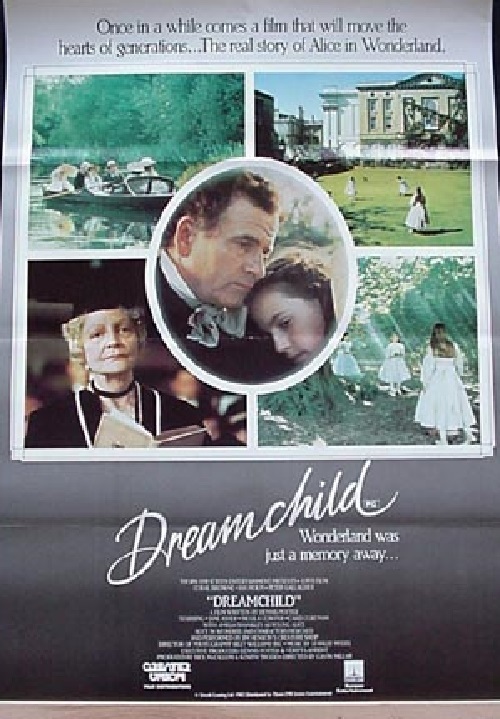
Dreamchild (1985) 's press releases, and how they reflected 20th century failings on Lewis Carroll

 A more informal version of this essay was written on my other blog.


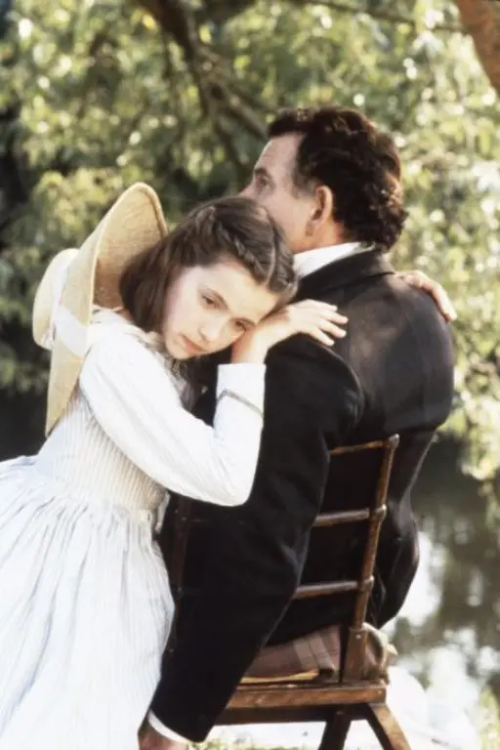
(Amelia Shankley as Alice Liddell, Ian Holm as Charles Dodgson (Lewis Carroll) , press photo for Gavin Miller and Dennis Potter's Dreamchild, 1985)

Finding press photos for this film has made me think about the very strange  press promotions at the time for this film. I’ve also written an academic paper on Lewis Carroll and portrayals of him in film and TV. I’ve probably spent too much time wondering why on earth this particular film is like the way it is. 

For those who don’t know, this film is marginally based on Florence Becker Lennon’s now debunked 1945 biography Victoria Through the looking Glass. Dennis Potter based the film on this, uncredited. He also based the film on his early 1965 tv play Alice, which also used Becker as a basis. If you want to know more about Becker, I recommend this page by Karoline Leach on early Carroll biographies.

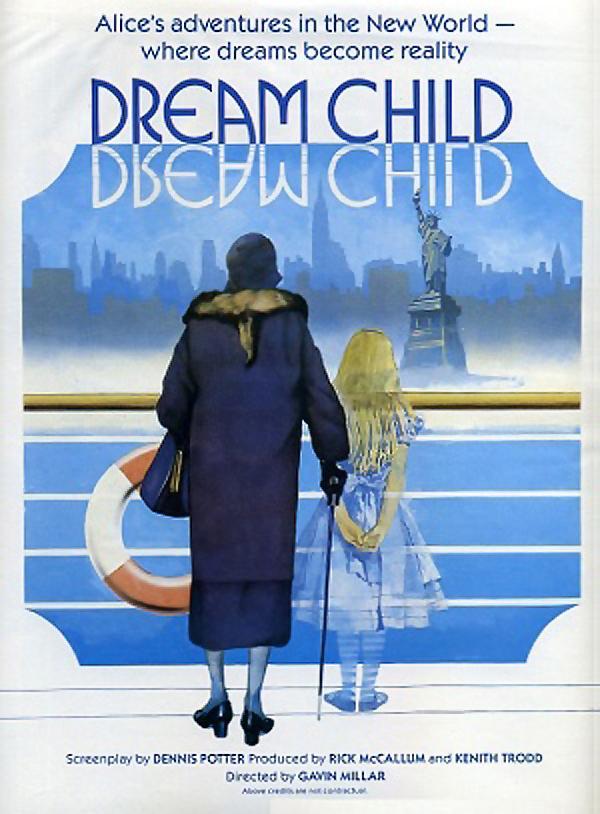
There is a general mix of uneasiness around the film’s story in the press releases (the film, as in Becker’s 1940s bio, depicts Carroll as basically a repressed pervert, something future biographers in the late 90s would expose as myth) but also a strange pushing of this theme from some parts of the press team. Several pieces of press from around this time (1980s french VHS trailer, this poster from an unknown country) seem to actively push the implied abuse in the film as a marketing point. Why this was done, I don’t know.

Other pieces, generally originating from the UK and US, push a “true story” biopic angle. You can see this in this poster for US audiences, and this one for the UK.

There are conflicting interviews by producers and those involved in the film. When asked about how the film characterises its fictionalised Lewis Carroll (as played by Ian Holm), both producer and director give VERY different remarks.

This is from a 1985 interview with director Gavin Millar (from starlog issue 101)

love and its various forms, and how it bends under the influence of society, inhibition, repression or morality. It wasn’t a film about a paedophile…it was about a man who was bursting with love for a series of objects

This contrasts with the opinions of producer Kenneth Trodd, who believed that Shankley’s young Alice and Holm’s Dodgson in the film had:

quite a definite, unspoken, unreal- ized, innocent sexual charge

Why did Millar and Trodd say these things? We can’t be sure, but my guess is due to marketing. Each quote plays with then rejects scandal. It wants things both ways. Running co current with these strands was a press strand about Henson and the puppetry used in the flashback sequences.

This strange mix of on one hand marketing scandalous undertones and on another, refusing to speak about the film’s content, is extremely reminiscent of biographer Karoline Leach’s remarks about the 20th century schools of thought on Lewis Carroll. On one hand, Freudians delighting in inventing ideas of perversion in Carroll, on another, the apologists who would only turn their faces away and refuse to refute the Freudians claims, despite evidence being available to do so.

Perhaps the 20th century was the worst time to attempt a carroll biopic? With the diaries not published in full until 1993 and much of biography of that era being made up of theories presented as fact. Not having access to someone’s personal papers breeds myth.

SOURCES:

BOOKS:

Leach, Karoline. In the Shadow of the Dreamchild: the myth and Reality of Lewis Carroll, Peter Owen Press, 2015. 

PHOTOS

Dreamchild Ian Holm Amelia Shankley. Alamy Photos 

https://www.alamy.com/dreamchild-ian-holm-amelia-shankley-date-1985-image156926801.html 

 IMDB: Dreamchild Poster 1985, Country Unknown

 https://www.imdb.com/title/tt0089052/mediaviewer/rm3212818945

Dreamchild UK 1985 Poster 2: Actors Highlighted . Accessed November 12, 2020. https://images.static-

https://images.static-bluray.com/products/20/38412_1_large.jpg

Filmaffinity: Dreamchild US Poster. Accessed November 12, 2020. 

https://pics.filmaffinity.com/Dreamchild-508564099-large.jpg

INTERVIEWS:

Pirani, Adam. “On the Set of Dreamchild.” Starlog Magazine no. 101, November 1985. 45 – 48.

ONLINE VIDEOS

Dreamchild 1985 Trailer, 2013. https://www.youtube.com/watch?v=4ef9ghnxZTQ 

FILM

Millar, Garth, Dreamchild. UK/US: Pfh Ltd, Thorn EMI, 1985. https://www.worldcat.org/title/dreamchild/oclc/921297099&referer=brief_results

Wednesday, 21 December 2022

Best/Worst Alice in Wonderland and Lewis Carroll related things I saw this year

 I watched so many things with friends this year that I can actually afford to do a year end list of Alice related stuff. So...

BEST

Alice in Wonderland: Black Light Theatre of Prague (1994) Directed by Jiri Snec (Youtube) 

This is not technically new at all, but it is new to the internet. It took a dear friend of mine neigh on 7 years to find the VHS of this obscure Japanese video of a Czech "black light" theatre performance. I think I can say on viewing that the wait was worth it. A silent theatre performance using aspects of dance, and using Carroll's books as a leaping off point for ever stranger spectacles. Marcela Skrbkova's Alice captures wide eyed wonder in the way most variations of the character don't. Even the darker aspects of this version (the addition of some menacing red birds) seem in keeping with the dark-light balance of traditional Czech fairy tales. I can't really do this justice in words, its one of those things you'll have to seek out for yourself and experience. 

MOST SURPRISING

Alice's Wonderland Bakery (2022) Directed by: Nathan Chew, Arielle Yett, Steven Umbleby, Donald Kim and Sarah Frost (Disney +) 

I'm breaking my rule here because this TV series has nothing to do with Carroll's books. But I'm writing this at Christmas and this IS a year end list. This is something friends and I enjoyed enormously towards the end of this year. Alice's Wonderland Bakery is inspired loosely by 1951 Disney where a new generation of Wonderland inhabitants form around "Alice" the supposed great great granddaughter of the 1951 Alice (the linage and connection is confused and contradictory, but just go with it) This new "Alice" owns a bakery, and the plots are based around cooking. Despite the strange, strange jumble of elements (Doorknob that moves everywhere? Dodo living on the Walrus and Carpenter beach? Talking cookbook? Rabbit hole as Bakery pantry?) the show eventually grows into something very adorable and the references to '51 do grow more thoughtful over time. Some episodes even seem to hint and play with concepts familiar to Carroll (we see a hall of doors in the Hearts' castle, and Alice and co embark on a deeply absurd search for a lost flower singer) By the end of the series, you'll be wondering why you ever doubted such a concept working. 

MOST FORWARD/2020s ADAPTATION


Alice nel mondo da Internet (2022) directed by: Fabrício Bittar (Netflix) 

OK so, this is on Netflix Brazil and also Mexico, but not UK or US outlets. You'll need to use internet trickery to watch and also download eng subs by yourself (subs by one of my friends who was good enough to translate for me)

This is a very fun made in lockdown 2020 version which brings the Alice books bang up to date by setting the story inside a laptop. Said laptop belongs to Alice, an arrogant young youtuber who has fallen out with a friend recently. During a livestream, Alice falls a long way down into her own desktop. In Wonderland she meets a cat meme, two twins who hold gateway entry, and an antivirus blue caterpillar who is obsessed with order. The joy of this adaptation is seeing how Wonderland and Looking glass characters and scenes are retold and reinvented to fit this updated tech theme. Although its packed with green screen, its very well done and not too intrusive. 

WORST


Alice (2022) Directed by François Roussilon (France Televisions) 

On one hand, this nightmare of a carroll myth influenced dance disaster DID give me excellent citation material for my essays on how fiction writers have misinterpreted Lewis Carroll, on another... it exists. Its one of the worst Alice related things I've ever seen, without any hyperbole. Please, even if you are curious about how wrong a portrayal of Carroll can be, do not seek this out. It is not worth your time. 

Sunday, 16 October 2022

A failed post about Sylvie and Bruno (1889, 1893)


 "Less Bread! More Taxes!" - Title of chapter 1 of Sylvie and Bruno

Sylvie and Bruno is an experimental 2 part novel by Lewis Carroll (Charles Dodgson), its his last major work.

The story is divided into 2 main strands: a love triangle set in England between a doctor, Arthur, for the Lady Muriel, and a fairy tale parody of Oxford University, "Outland" with 2 fairy characters, the children of the title. Loosely connecting these two strands is the narrator, an elderly gentleman prone to a condition similar to narcolepsy who sees both these worlds, often in tandem. 

This summary is as close as I can approximate this novel for anyone. Somehow in the space of 2 years an aging Charles Dodgson decided to throw every idea he'd ever had into a novel and see if it stuck. Originating as a short story ("Bruno's Revenge", published in Aunt Judy's Magazine, 1867) the book grew ever complex, split into 2 parts and with seemingly endless tangents on Religion, Morality, and Love. It flopped upon release and faded into obscurity, with only major Carroll scholars and a few writers here and there acknowledging it. 

Whilst Dodgson at the time may have considered it to be his best piece of work, for the modern reader it is almost impossible to read (and I should know - I attempted it in 2020 and barely made it through, if it wasn't for friends) I was thinking over recently why this is just so hard to read, and realized that unlike later experimental novels or poetry, a context guide, notes or introduction has seemingly never materialized in the mainstream for Sylvie and Bruno. A scholarly annotated version exists: but it is not for the casual reader or carrollian. 

The context guide I found online last year seemed to give up halfway through, confusing one chapter for another.  This is an oversight in my eyes as a simple guide would make the whole book far less daunting to new readers and also explain just what Dodgson is saying in the sections where characters debate 19th century values. And also, why the concept of fairy children existed in Victorian literature and its link to mortality issues. 

This is a book which places you in a room in Outland (an Oxford parody) in chapter 1 with the phrase "-And then the people cheered again" and leaves you to slowly decipher its plot, or to wonder if it even has any grasp of one. Any idea of plot is tied up in Outland with a conspiracy by the Sub Warden and Chancellor to oust the Warden of the university, and in the real world, formed around Arthur and Muriel's relationship. Transitions from waking to dreaming flip back and forth so suddenly you may not be aware the narrator is awake or asleep. There are sections that work. There are sections that really don't. There are poems, often with a moral (something that a younger Dodgson would have winced at, most likely)

Within this maze, there is something to be commended: Dodgson tried to write one of the first experimental novels with only a vague idea of what he wanted. But I believe his ideas of this being a grand work, would be with editions that fully explained his vision, with notes and footnotes. 

At this moment the novel is hellishly difficult to understand because it requires you know 19th Century English culture, Oxford, Christianity and mental states well enough to engage with what Dodgson is offering. For most people (myself included) this is most likely too much to handle. 

I didn't want to dislike this book at all. But without proper context: it becomes almost utterly meaningless. 

NOTES:

  • A case for this novel as extremely early Experimental Literature is made persuasively by Thomas Christensen's 1991 article for Right Reading. 
  • An abridged version of the novels, called "The Story of Sylvie and Bruno" was published in 1904 and includes only the Outland strand of the narrative. Many translations omit the social realism side of the story, for example in Polish. 

Monday, 4 July 2022

All in the golden afternoon (Poem by Lewis Carroll, 1865)

NOTE

This poem is about the boating party in the Summer of 1862. As ever with Dodgson it is laced with a lethal wit. Here Dodgson jokingly identifies himself as the "wary one" the storyteller, Prima is Lorina, Secunda is Alice, and Tertia is Edith. The three Liddell sisters who along with Canon Robinson Duckworth, heard the tale of Alice over the summer. In the poem, they are jokingly referred to as the "cruel three", the people that make the teller of the Alice tale keep going. The "dreamchild" that is in this poem refers to the fictional Alice. Dodgson always took great pains to differentiate the fictional Alice of his stories from his friend Alice Liddell. 

ALL in the golden afternoon

Full leisurely we glide;

For both our oars, with little skill,

By little arms are plied,

While little hands make vain pretence

Our wanderings to guide.

Ah, cruel Three! In such an hour,

Beneath such dreamy weather,

To beg a tale of breath too weak

To stir the tiniest feather!

Yet what can one poor voice avail

Against three tongues together?

Imperious Prima flashes forth

Her edict 'to begin it' -

In gentler tone Secunda hopes

'There will be nonsense in it!' -

While Tertia interrupts the tale

Not more than once a minute.

Anon, to sudden silence won,

In fancy they pursue

The dream-child moving through a land

Of wonders wild and new,

In friendly chat with bird or beast -

And half believe it true.

And ever, as the story drained

The wells of fancy dry,

And faintly strove that weary one

To put the subject by,

"The rest next time -" "It is next time!"

The happy voices cry.

Thus grew the tale of Wonderland:

Thus slowly, one by one,

Its quaint events were hammered out -

And now the tale is done,

And home we steer, a merry crew,

Beneath the setting sun.

Alice! a childish story take,

And with gentle hand

Lay it were Childhood's dreams are twined

In Memory's mystic band,

Like pilgrim's wither'd wreath of flowers

Pluck'd in a far-off land. 

4th of July


(Dodgson's original drawing of the fictional Alice, via British Libary)

Today marks 4th of July 1862, the day that Charles Dodgson, on a whim during a boat trip in Oxford, began telling the story that would become Alice's adventures in Wonderland to Robinson Duckworth, Edith Liddell, Alice Liddell, and Lorina Liddell. The tale continued over subsequent weeks and further into the summer.


(Photo, detail of Christ Church, Oxford, image by Wordlander)

ARTE's documentary which now is uploaded with English subtitles to my Youtube and Archive.org (with thanks to @Hatteriastrange for subbing) goes into this day in more detail :)