NOTE JANUARY 2025: NEIL GAIMAN IS AN ABUSER, I WROTE THIS PIECE FAR BEFORE ANYONE KNEW. PLEASE READ THE SIDE OF NEIL GAIMAN HIS FANS NEVER SAW, BY LAUREN STARKE (TRIGGER WARNINGS APPLY)
NOTE: This is a piece comparing this film to the down the rabbit hole trope and Lewis Carroll’s Alice novels.
PLEASE NOTE THAT THIS IS AN ANALYSIS OF THE 2009 FILM, NOT THE ORIGINAL NOVELLA.
ALSO, SPOILERS.

PLEASE NOTE THAT THIS IS AN ANALYSIS OF THE 2009 FILM, NOT THE ORIGINAL NOVELLA.
ALSO, SPOILERS.
Coraline in relation to the Down the Rabbit Hole Trope
Where in the world do I begin with this?
The film does conform to the archetype for the most part, with Coraline visiting the Other World and eventually being called upon to save her family. But what separates this film from its nearest cousin, Spirited Away (2001) is that whilst the Spirit World portrayed in that film is harsh and disorientating for the protagonist, the world that Coraline visits literally wants to entrap her. Yes, what we have here is one of the most darkest variants on this archetype. What really brings this home is that (unlike the novel) Coraline visits the Other World various times before it shows its true colours, and the Other Mother’s intentions are made clear. After that the film explores the dark undercurrent of the down the rabbit hole archetype.
Coraline’s identity
Interestingly, all of the films I have looked at in this series of posts all seem to involve the protagonist loosing their identity. It is true of the archetype codifier, Carroll’s Alice novels, where Alice looses her identity twice in the two books (Once in Wonderland when she wonders who she is, again in the Looking-Glass World whilst in the Wood where things have no names)
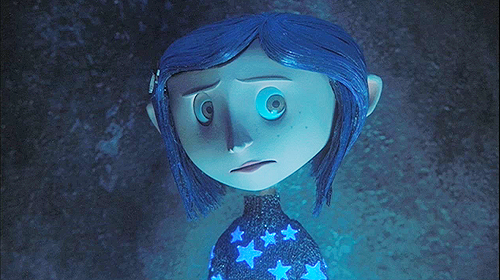
But if Carroll’s novels merely suggest this, the films inspired by Alice’s adventures have undoubtedly taken this to its extreme. This pattern of storytelling reaches its logical conclusion in this film, in which Coraline’s very soul is at stake. When she is offered to stay in the Other World by her Other Mother, a pair of shiny black button eyes is presented to her.
To stay in this world, she’ll have to sacrifice who she is and her identity. And eyes of course, have long been associated with the soul.
The Ghost Children are souless, and without their souls they are unable to escape their prison. Their stories are almost identical to Coraline’s except that they gave in to the Other Mother.
Alice’s portals
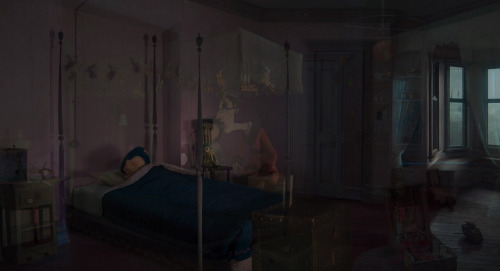
Coraline significantly reaches the Other World in three different ways, all of which link in with Carroll’s Alice novels. The first (unique only to the film, not in the novella) is by dreaming. Coraline reaches the other world the first two times when she is asleep, although these dreams later are proved to be real.
Alice’s adventures in both Wonderland and the Looking-Glass World prove to be nothing more than bizarre dreams.
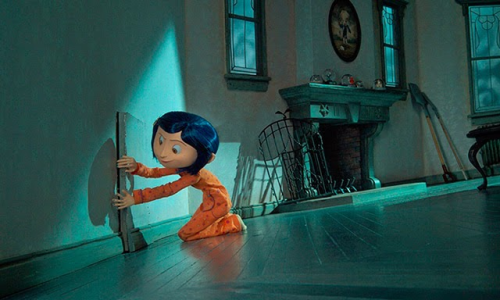
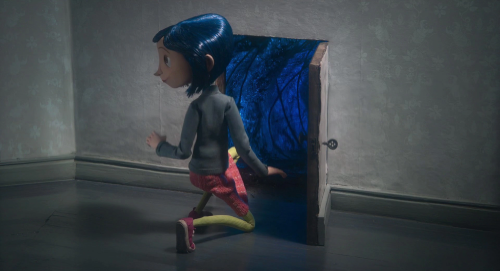
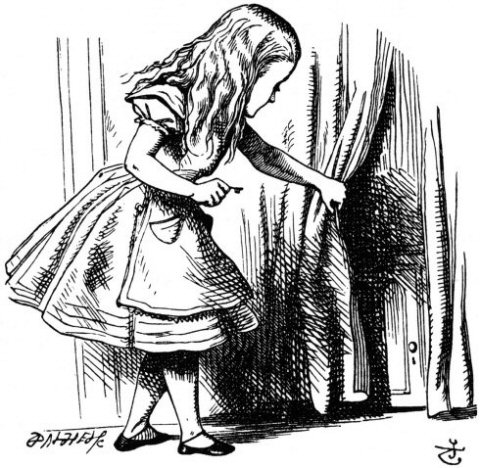
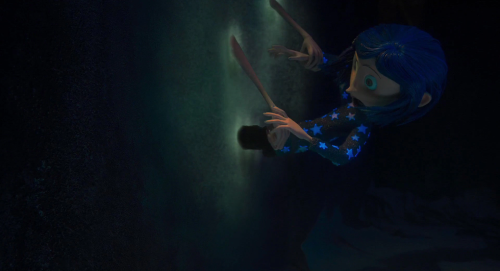
The second portal is via a small door in the drawing room, which is meant to be bricked up. It slightly recalls the small door leading to the Queen of Hearts’s Garden in Wonderland that Alice wishes to go through at the beginning of Alice’s adventures in Wonderland.
Alice opened the door and found that it led into a small passage, not much larger than a rat-hole: she knelt down and looked along the passage into the loveliest garden you ever saw. How she longed to get out of that dark hall, and wander about among those beds of bright flowers and those cool fountains, but she could not even get her head though the doorway
But similarly to Coraline, once Alice is through the door, the beautiful surroundings hide a darker presence. In Alice’s case, it turns out to be the garden of the tyrannical Queen of Hearts. The garden that Coraline finds in the Other World turns dangerous once she refuses to give up her identity.
Lastly, although not an entrance to the Other World, Coraline enters a small room containing the Ghost Children when she is put through a mirror.
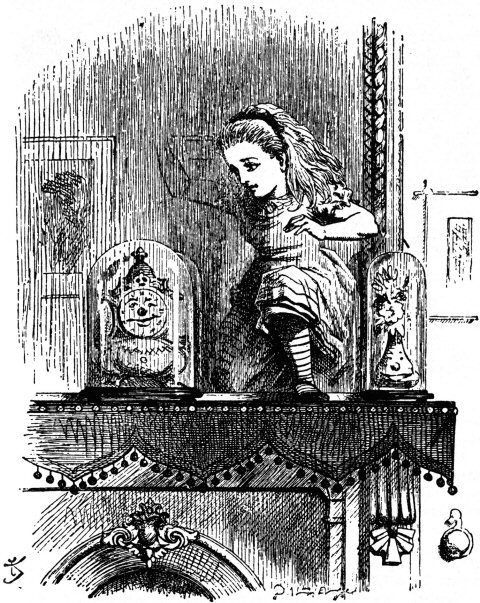
Alice enters the Looking-Glass World famously through a looking-Glass. The difference here is that Coraline enters the Ghost Children's realm out of punishment, whereas Alice finds her way into Looking-Glass House completely voluntarily.
A disappearing Cat as a guide or ally.
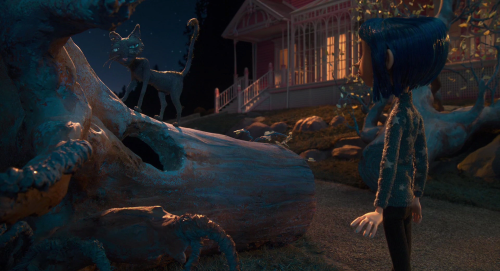
Coraline even has its own variant on Carroll’s Cheshire Cat, the Cat in Coraline is a sarcastic guide and only ally to Coraline in the Other World apart from the Other Wybie. Just like Carroll’s famous cat, the Cat can disappear at will.
In Carroll's Alice similarly the Cheshire Cat is characterised as a slightly infuriating guide as he offers information about the nature of Wonderland and directs Alice to the March Hare's House.