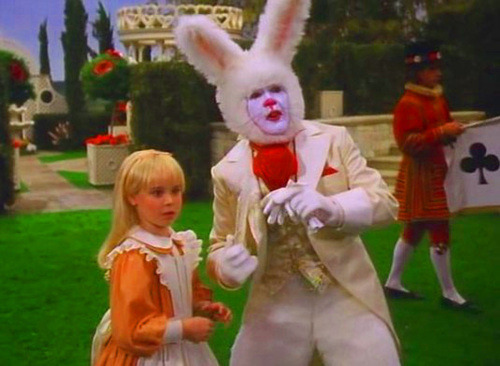
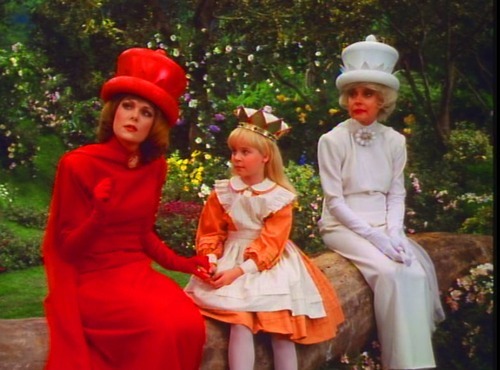
 I’ve never been quite sure on this film, to be honest. I know that a lot of people love it and some people can’t stand it. But I’m sort of in the middle on this one. There’s some really good parts and some not so good parts.
Part 1 adapts Alice in Wonderland and part 2 adapts through the Looking-Glass. The screenwriter also adds a subplot about Alice wanting to be older and to grow up, and introduces the idea of her adventures teaching her a lesson. Although this might sound awful it is actually well executed for the most part and blends in well with the stories. Carroll’s dialogue is often watered down a bit, but this is a hollywood-ized version of the Alice stories if you will, so its sort of expected and not too annoying.
However the songs are quite a different thing, like the performances of the actors, the songs are either really good, OK or terrible. Unfortunately the worst song “I hate Dogs and Cats” sung by the mouse, is the first one we hear. The songs do get better and are really good in the Looking-Glass adaptation.
In terms of actors, Natalie Gregory’s Alice takes a long time to get used to as she is not Carroll’s Alice but by the time we get to part 2 we’ve warmed to her more. The acting again ranges from the good (Sammy Davis Jr as the caterpillar, complete with tap dancing “You are old Father William” sequence, surely one of the highlights of the Wonderland adaptation, also Ann Gilllian as the Red Queen is great, one of the best parts of the Looking Glass adaptation) and the not so good (Ringo Starr as the Mock Turtle)
I like the fact that this film attempts to adapt both books back to back and fully. We actually get a fully fledged adaptation of Through the Looking-Glass here, which is really nice to see. On the flipside Carroll’s dialogue is often thrown out of the window in some scenes.
For example when Alice talks to the gnat in the Looking-Glass act, he simply warns her not to go into the wood. I would have liked to have seen the conversation that’s in the novel about the looking-glass insects. But what is in here is very good, we get the Walrus and the Carpenter as well as You are old father william and The Lion and the Unicorn. Most of Carroll’s poems are here, if not all.
Overall, I have mixed feelings about this adaptation and despite its flaws, I really admire its overall ambition to dramatize more of Carroll’s stories.
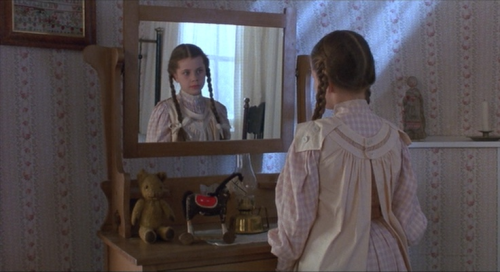 NOTE: as much as I’d like it to be, this is NOT an analysis of the original Baum books “Land of Oz” or “Ozma of Oz”. It just focuses on this film.
ARCHIVE NOTE: This review was originally dedicated to the blog Phantomwise.
REVIEW CONTAINS HEAVY SPOILERS!
 Return to Oz in relation to the down the rabbit hole trope.
Unlike other films I’ve covered for this project, Return to Oz is unique in the aspect that the protagonist has already been “down the rabbit hole” once, and has unwittingly stumbled back down once again, that doesn’t mean that Dorothy knows and understands every character or place in Oz, not at all, because the place has changed…. Dramatically.
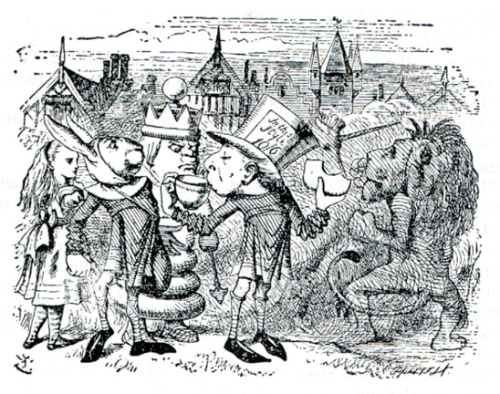 In a way, this is comparable with Carroll’s Through the Looking-Glass. Although Alice doesn’t return to anywhere, Looking-Glass World is often suggested by academics to have inverse, interloper characters from Wonderland, Hatter is now Hatta, the March Hare is now Heigha, and in true Alice-style, Alice doesn’t recognise them from her prior dream.
`He's only just out of prison, and he hadn't finished his tea when he was sent in,' Haigha whispered to Alice.
But as an author, Carroll never makes the characters Hatter and March Hare in the text, and most of these theories are founded on Tenniel’s illustration of the characters.
Dorothy does, in contrast, find her companions from her last adventure, but they are also altered, turned to stone by the Nome King’s corruptible force. At the end of the film, once freed, they seem distant from Dorothy. The main characters from the last book are for the most part side-lined for a group of equally unusual friends.
In Through the Looking-Glass, Alice encounters possible versions or variants on the Hatter and March Hare only once. There is no attempt by Carroll to link the two settings. The place behind the looking-glass has its own identifiable name, after all...
"To the Looking-Glass world"
Likewise, this film mostly avoids characters who appeared in the first book.
Carrollian motifs
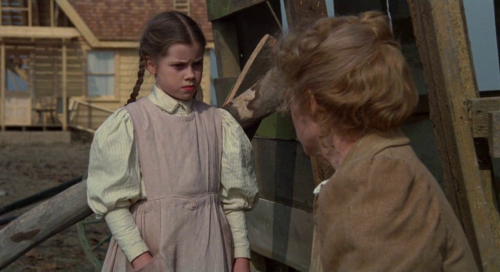 The film also is preoccupied with Carrollian motifs. Through minor motifs such as Dorothy’s pinafore dress, worn at the beginning of the film, and the small golden key she finds in the real world which later helps her unlock doors in Oz, to bigger, more substantial symbols.
After Dorothy successfully wins her friends back from the Nome King, the castle she is in breaks to pieces, leaving her falling down a colourful abyss.
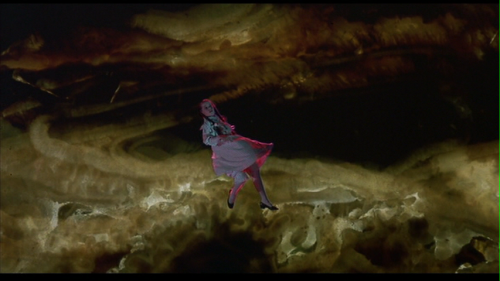 I point out a comparison with Carroll’s Alice’s adventures in Wonderland:
The rabbit-hole went straight on like a tunnel for some way, and then dipped suddenly down, so suddenly that Alice had not a moment to think about stopping herself before she found herself falling down a very deep well.
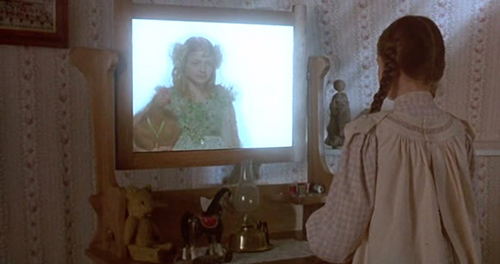 Dorothy also enters halls of mirrors whilst in the palace of Princess Mombi, and sets Ozma, rightful heir to the Oz throne, free via pulling her out of a mirror. At the end of the film, it is shown that anytime Dorothy traces the word “Oz” in a mirror, Ozma is there looking at her, implying she can come back anytime she wishes. And the way back? Probably through a mirror.
In Through the Looking-Glass, Alice enters looking-Glass World by passing through her drawing-room mirror.
Beloved Pets and other lands
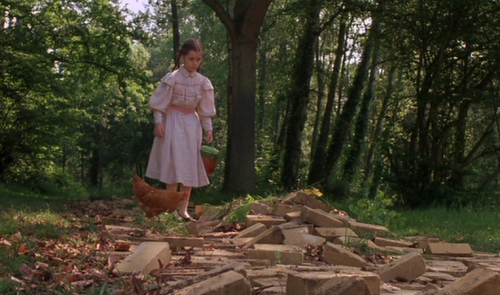
Billina the chicken shares a similar function to Dinah, both are beloved pets and reminders of the protagonist’s real world existence, but interestingly Berllina gains sentience when Dorothy enters Oz, and helps her on her journey, ultimately destroying the Nome King via an egg.
In contrast, Alice’s beloved cat Dinah is talked of in Alice’s adventures in Wonderland but never seen. Alice pretends her cats Kitty and Snowdrop have sentience in through the looking-Glass but they never follow her to the other side of the mirror at all.
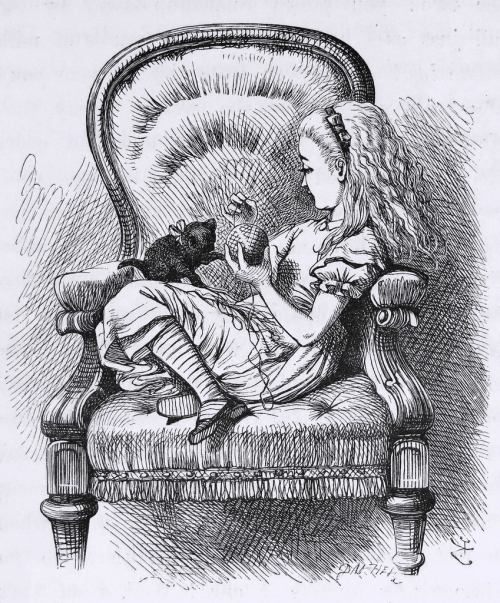
“I was very nearly opening the window, and putting you out into the snow! And you’d have deserved it, you little mischievous darling! What have you got to say for yourself? Now don’t interrupt me!’ she went on, holding up one finger.
Defiance against ruthless monarchs
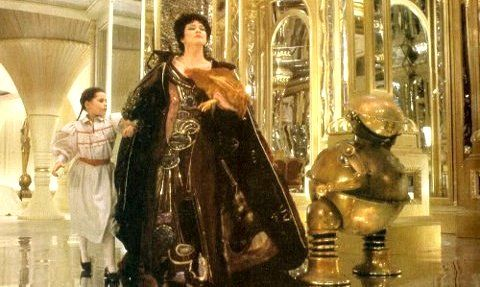

Princess Mombi’s obsession with heads is taking Carroll’s Queen of Hearts to the next level, unlike Carroll’s Queen, Mombi’s obsession with beheading and keeping different heads certainly isn’t just
all her fancy
The scene when Dorothy meets her is also echoing the scene in the garden in Alice’s adventures in Wonderland. Dorothy and Alice both use politeness strategies as a way of dealing with the royalty’s savagery, and when that doesn’t work they resort to speaking their minds.
`Nonsense!’ said Alice, very loudly and decidedly, and the Queen was silent.
Both protagonists even curtsy upon meeting their retrospective monarchs, which as both stories are respectively set in the Victorian and late Edwardian period, would be the expectation for a young girl encountering royalty.
Both of these scenes end with the threat of execution and the protagonists forced to fight back, Alice turning away defiantly and calling the Queen’s ideas nonsense, Dorothy running and using her chicken Billina as a shield against Mombi.


