Wednesday, 10 April 2019

ARCHIVE POST: What is the use of a book review: Valerie and her Week of Wonders by Vitezslav Nezval


image


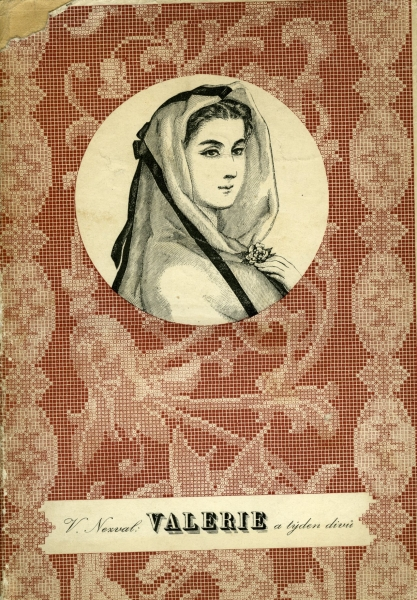
(Above photo: Kamil Lhotak's design for the first edition) 

Publisher (English Translation) : Twisted Spoon Press 

Content warnings: Implied sexual assault 

Well, um… this will be interesting to be sure. My fellow Carrollians you must appreciate that this is a very, very difficult book to review. Its very difficult to describe and at least half of the novel comes down to personal interpretation. But I’ll give you my best shot at a plot overview.

Valerie, a 17 year old innocent girl, lives with her decrepit grandmother in the midst of the Czech Republic in the medieval era. When she is finally old enough to be considered a woman, her earrings are stolen by a young man named Eagle and then returned to her. After seeing a vision of a horrifying vampire-like man known as the Polecat, she retires home to bed. Only for her week to become increasingly bizarre as she is approached by various vampiric villagers. The only thing that can save her from these strange encounters are herself and her magical earrings. Whether Valerie’s week even happens is debatable. It could all just be a utterly surreal dream…

First things first, if you hate confusing, surreal or convoluted plots, I would advise you not to read this. After the set up is established it becomes truly nonsensical. However, if you don’t mind, be prepared for a searingly strange yet intriguing story which shifts its tone back and forth through several genres. Is it surreal horror? A adult’s fairy tale? A Alice-like tale of a girl encountering bizarre things? Its technically all of these at once.

Valerie as a protagonist brings to mind Carroll’s Alice several times. Valerie is determined to get to the bottom of all of the strangeness that envelopes her- even if it could all be imagined. Unlike her counterpart in the 1970 film, book Valerie is often frightened by the things she encounters- but never to the point of despair. She never gives up entirely. 

And then there are the lovely illustrations by Kamil Lhotak, inspired by Victorian collages. They are stunning. 

There have since been illustrations for Japanese and German editions (the Japanese illustrations being less abstract) which are also just as interesting as Lhotak's originals.

If you’re feeling brave enough, its well worth the read. 

Tuesday, 9 April 2019

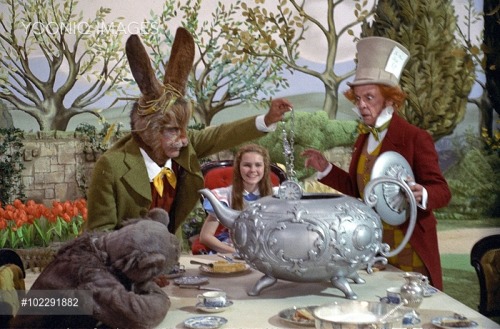
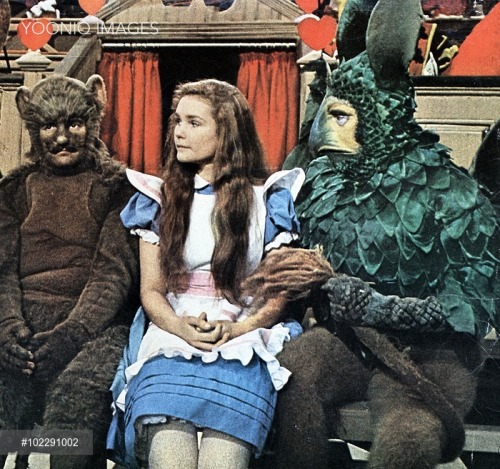
Promotional Images for 1972 (ARCHIVE)


Photo sources: Pyooniq Images (now seemingly defunct.. sadly)  

ARCHIVE POST: Alice Film Opinion: Alice through the Looking-Glass (1982)

image

First off, sorry that this commentary is a bit late but I really had to gather my thoughts before I talked about this one. Before I go on to talk about this film I should tell you this- I am very bias towards this adaptation. Very. I love every part of it. Seriously this is in my top 5 Alice adaptations.

This is, in my opinion one of the best adaptations of the second Alice book ever filmed. One of the few fully fledged adaptations, this one boasts the unique idea (Only seen again in Irwin Allen’s 1985 film) of having the same actress reprise the role as Alice. In this case, its Marina Nylova’s voice acting. I really like this idea and I wish more versions were made with this ideology.

image

The animation is an improvement on the last film, with the cut-out animation blending in better with the traditional animation. Unfortunately in this film we don’t see the black and white representations of Alice’s thoughts, which is a shame, although we do get some great visual representations, for example the Red Queen’s bizarre questions (like the dog’s temper one)  and a interesting take on “the Jabberwocky”, complete with Alice imagining that she is the hero of the poem.

In translation to Russia things inevitably change a bit, which makes for a fascinating look at how this story is interpreted by another culture. Here the only major change is that the Red Queen becomes the Black Queen. In the last film “how doth the little crocodile” was substituted for another poem. That was also very interesting.

Aside from that the script is almost completely verbatim from Carroll, it feels like it was made by someone who loved the book very much and you can tell. From the opening shot of the snow outside Alice’s house, right to the end. The voice acting is fantastic as always, but a special mention goes to the White Knight, he is apparently a singer and he does a excellent job of singing a condensed version of “A sitting on a gate”


I’m sorry if this commentary is turning into me gushing about this version. I just love it. Its beautifully made and well adapted. The only downside is that, unlike the 1981 wonderland adaptation, it is less easier to find, especially with English subtitles. If you do ever come across a subtitled version, please watch this film. Its fantastic and deserves to be seen by Carrollians.

ARCHIVE POST: SCRIPT REVIEW: Simon Reade’s Alice’s adventures in Wonderland

image

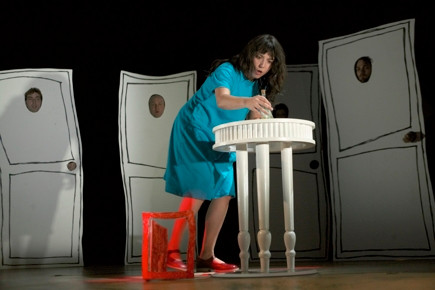
(Celia Meiras as Alice in the 2005 World premiere, photo from Theatrebristol.net)

image

Simon Reade’s Alice’s adventures in Wonderland adaptation premiered in Bristol at the Old Vic in 2005, before being revived 9 years later. In between these two productions was one outdoor amateur performance and a low key American premiere. 

Its a massive shame that productions of this script don’t come around very often. Because it is very well done indeed.

After an argument with her Sister about responsibilities (think of the 1985 Irwin allen miniseries and you’re not far off) Alice is surprised to see her toy white rabbit transform into a fully grown, massive one. Not only is it alive, it is carrying a pocket watch and mutters about being late. Fed up with reality anyway, Alice follows it and soon finds herself in a strange world very far from home…

Unlike in other adaptations, Reade’s Alice quickly regrets that decision. His version of Alice is somewhat immature and fearful, not that she can’t hold her own against the Queen of Hearts of course. Wonderland here is represented as marvelous but also frightening. A lot like the original novel actually. There is a beautiful garden but there is the Queen of Hearts. There is the mad tea party but there is also the Gryphon, who in this version is also the executioner.

Reade also does an excellent job of updating the dialogue- not quite to modern parlance but just to update the more archaic Victorian language, so an audience of children aren’t confused. So the Caterpillar’s “Are you content now?” line from the book becomes “Are you happy with your size now?” 

But don’t worry, Carroll’s poems still remain entact as ever. In an unusual move, Reade ditches the Fury said to a mouse poem and instead opts for Carroll’s manuscript poem for the mouse: “We lived beneath the mat…” 

.Alice is arrested by the Queen of Hearts at the croquet game which gives Reade a unique opportunity to set the Mock Turtle’s story and Lobster Quadrille scenes in a prison. Complete with imprisoned mock turtle. 

Another interesting aspect of this adaptation is the fact the Knave of Hearts doesn’t exist. This means that the trial scene is reworked to become Alice’s trial, accused of disturbing Wonderland and its residents. Alice’s argument with the Queen of Hearts strangely resembles her argument with her Sister back in the real world at the start of the play. To emphasis this fact, some stagings of this script have had Alice’s sister also play the role of the Queen of Hearts.

Alice denys the crimes and accuses the Queen of misinterpreting the evidence. Which is true. As you can imagine, this does not go down well with either the court or the Queen. 

Alice is actually lead to a guillotine by the Gryphon-turned executioner at the climax, one of the darkest that I’ve seen in a stage adaptation.

Thankfully, Alice wakes seconds afterwards. Fearful, she sings a verse from Carroll’s all in the golden afternoon preface poem before realizing that it was in fact, all a dream.

The last scene shows Alice as a adult, with a child of her own, harking back to the final paragraph of Carroll’s novel. Alice’s child plays with the toy white rabbit from the beginning, before the story seemingly starts all over again. 

Overall, a lovely production which should be produced more often. 


Also, I now want Simon Reade to adapt Through the Looking-Glass.