
Wednesday, 10 April 2019

ARCHIVE POST: A stage review: Quantum Theatre’s Alice through the Looking-Glass

image

image

ARCHIVE NOTE: This review was for the 2017 cast. Originally reviewed in August 2017.

UK based Carrollians…. if it tours near you, please go and see this….

After a long absence I finally got to see this version again for the first time since its 2009 premiere! Has it changed for the better? In short- yes. And then some.
image

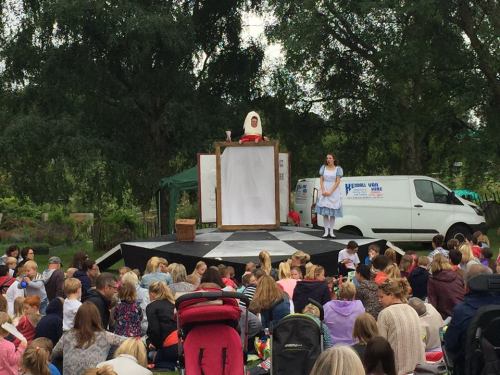
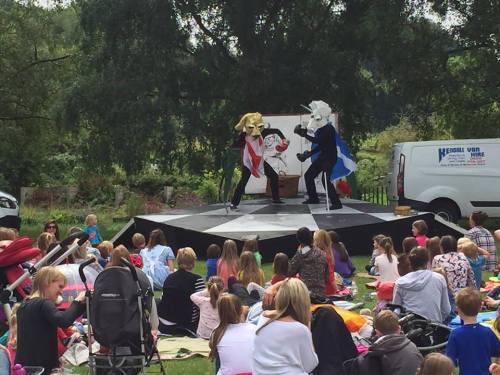
Indoor or outdoor, professional (or in this case) semi-professional, a good adaptation of Looking-Glass should make you feel like the first time you read the book. And with that Quantum completely succeeds. Its remarkable how this 3 piece company manage to convey everything (and I mean everything, no scene is left out!) from Carroll’s novel. This version feels very handmade in terms of staging, with one wooden rectangle doubling up as a mirror, a train carriage, a table, a door, even a boat. 3 actors and limited instruments also add to the chamber feel of this adaptation. Indeed, the music motif which runs throughout the play (which is “to the looking-Glass world…”) and many of the poems recited and sung are accompanied with flutes and the occasional drum, making everything feel very quaint.

In terms of changes from the 2009 production, puppets of the Red King, Red Queen, White Queen and the looking-Glass insects are now added, making the adaptation feel even more endearing. Awww! 

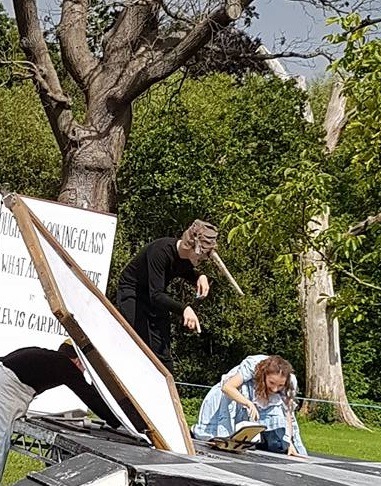
 But the real driving force of this version comes from the actors. 2 of them play all of the residents of Looking-Glass World between them. Changing between characters with their voices and quick costume changes. An actor will become the sheep or a gnat or the White Knight by putting on a head mask or throwing on a chess crown or ears. In the banquet scene, the actor playing the White Queen also voices the mutton, pudding, and a waiter! All by incorporating lightening fast costume changes into the action to make the audience laugh even more (since Carroll’s source text, unchanged here, is very very witty) 
image

A particular standout is the Gnat, who is not like the Gnat in the 1985 Irwin Allen TV series, or the 1998 Channel 4 adaptation. In those adaptations the Gnat was calm, sitting on a rock or tree. Not so here! Here he buzzes round the stage quite literally, never taking a second to sit down. I can’t help but wonder how the actor managed it. As someone who was used to other adaptations I found this interpretation rather funny. Going from a character who barely walks around to one who can’t stay still for more than a second! 
image

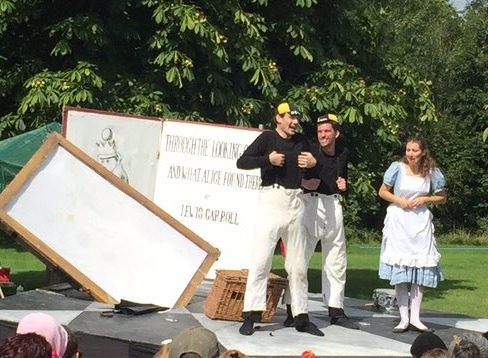
Dum and Dee were enjoyably obnoxious as ever and acted to perfection. This adaptation was particularly sly adapting the Red King scene. In this version you really got the sense that Dum and Dee were absolutely mocking Alice regarding the Red King dream theory. 

Essentially- the actors nailed the characters. All of them. 

The garden of live flowers perhaps could of done with more company members, as could the train sequence and the end banquet, all of these scenes are well handled, but you miss the company pieces they are meant to be somewhat… the end banquet looses some of its chaos a little because of this, but the actors had an interesting solution, instead of Alice destroying the banquet table by pulling the tablecloth, she is carried by the actors into the air whilst the Red and White Queens seem to drift in some kind of sea. Its a strange moment, but one that fits. Interestingly the armchair that Alice falls asleep in doesn’t exist in this version, so she awakes curled up next to a table on which Kitty perches. 

A sitting on a Gate and all of the poems are handled with great care and humour. In particular a sitting on a gate gets very funny, with the White Knight reciting the last verse a cappella as the musicians have gotten bored of the poem going on… and on… and on… As someone who is more used to Ian Holm’s nostalgic and somber take on the poem in the 1998 film, it was interesting to see a comedic interpretation. 
image

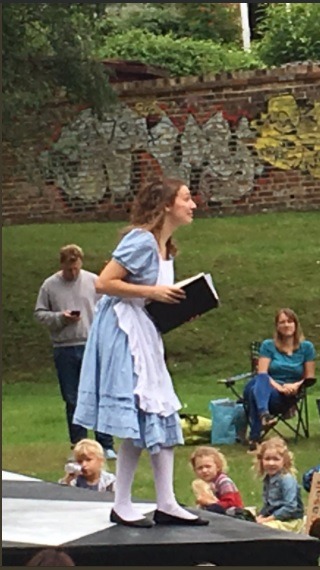
The main plaudits of this version and this particular cast really have to go to Hannah Allen, who played Alice. A newcomer to this particular role, Allen presented us with a book accurate eccentric Alice, but with a hint of feisty-ness thrown in for good measure. In the 2009 cast, Miranda Rozkowaski’s Alice had an air of cautiousness and confusion.  It seems unfair to compare the two interpretations as they both offer excellent takes on the same character.

Although confused by the world she had found herself in, Allen’s Alice seemed far more concerned with exploring every wonder she came across. Alice here was also more eccentric. After the Red and White Queens disappear after falling asleep, Alice twirls around singing “hushaby lady…” to herself, spinning around in pure joy. If anything captures that character’s essence, its that small scene. Lovely. 

There is so much more. I can’t fit it all in. 

If its revived (even with a different cast) and you're in the UK, please see it! 

ARCHIVE POST: What is the use of a book review: Valerie and her Week of Wonders by Vitezslav Nezval


image


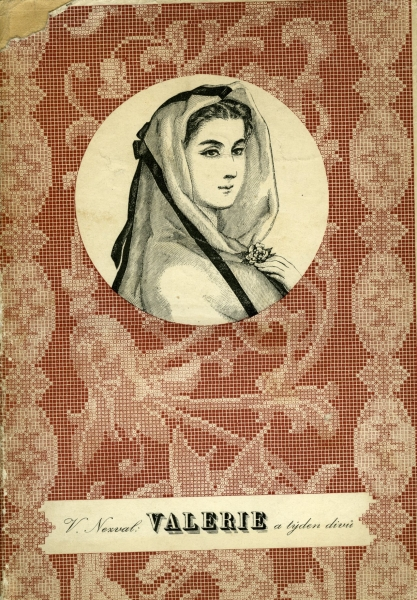
(Above photo: Kamil Lhotak's design for the first edition) 

Publisher (English Translation) : Twisted Spoon Press 

Content warnings: Implied sexual assault 

Well, um… this will be interesting to be sure. My fellow Carrollians you must appreciate that this is a very, very difficult book to review. Its very difficult to describe and at least half of the novel comes down to personal interpretation. But I’ll give you my best shot at a plot overview.

Valerie, a 17 year old innocent girl, lives with her decrepit grandmother in the midst of the Czech Republic in the medieval era. When she is finally old enough to be considered a woman, her earrings are stolen by a young man named Eagle and then returned to her. After seeing a vision of a horrifying vampire-like man known as the Polecat, she retires home to bed. Only for her week to become increasingly bizarre as she is approached by various vampiric villagers. The only thing that can save her from these strange encounters are herself and her magical earrings. Whether Valerie’s week even happens is debatable. It could all just be a utterly surreal dream…

First things first, if you hate confusing, surreal or convoluted plots, I would advise you not to read this. After the set up is established it becomes truly nonsensical. However, if you don’t mind, be prepared for a searingly strange yet intriguing story which shifts its tone back and forth through several genres. Is it surreal horror? A adult’s fairy tale? A Alice-like tale of a girl encountering bizarre things? Its technically all of these at once.

Valerie as a protagonist brings to mind Carroll’s Alice several times. Valerie is determined to get to the bottom of all of the strangeness that envelopes her- even if it could all be imagined. Unlike her counterpart in the 1970 film, book Valerie is often frightened by the things she encounters- but never to the point of despair. She never gives up entirely. 

And then there are the lovely illustrations by Kamil Lhotak, inspired by Victorian collages. They are stunning. 

There have since been illustrations for Japanese and German editions (the Japanese illustrations being less abstract) which are also just as interesting as Lhotak's originals.

If you’re feeling brave enough, its well worth the read. 

Tuesday, 9 April 2019

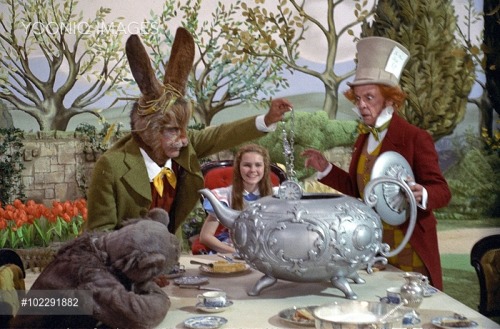
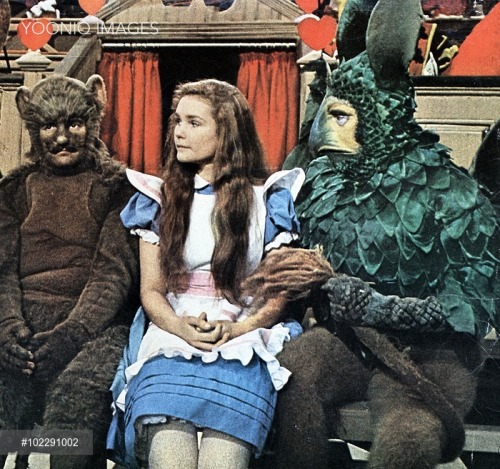
Promotional Images for 1972 (ARCHIVE)


Photo sources: Pyooniq Images (now seemingly defunct.. sadly)  

ARCHIVE POST: Alice Film Opinion: Alice through the Looking-Glass (1982)

image

First off, sorry that this commentary is a bit late but I really had to gather my thoughts before I talked about this one. Before I go on to talk about this film I should tell you this- I am very bias towards this adaptation. Very. I love every part of it. Seriously this is in my top 5 Alice adaptations.

This is, in my opinion one of the best adaptations of the second Alice book ever filmed. One of the few fully fledged adaptations, this one boasts the unique idea (Only seen again in Irwin Allen’s 1985 film) of having the same actress reprise the role as Alice. In this case, its Marina Nylova’s voice acting. I really like this idea and I wish more versions were made with this ideology.

image

The animation is an improvement on the last film, with the cut-out animation blending in better with the traditional animation. Unfortunately in this film we don’t see the black and white representations of Alice’s thoughts, which is a shame, although we do get some great visual representations, for example the Red Queen’s bizarre questions (like the dog’s temper one)  and a interesting take on “the Jabberwocky”, complete with Alice imagining that she is the hero of the poem.

In translation to Russia things inevitably change a bit, which makes for a fascinating look at how this story is interpreted by another culture. Here the only major change is that the Red Queen becomes the Black Queen. In the last film “how doth the little crocodile” was substituted for another poem. That was also very interesting.

Aside from that the script is almost completely verbatim from Carroll, it feels like it was made by someone who loved the book very much and you can tell. From the opening shot of the snow outside Alice’s house, right to the end. The voice acting is fantastic as always, but a special mention goes to the White Knight, he is apparently a singer and he does a excellent job of singing a condensed version of “A sitting on a gate”


I’m sorry if this commentary is turning into me gushing about this version. I just love it. Its beautifully made and well adapted. The only downside is that, unlike the 1981 wonderland adaptation, it is less easier to find, especially with English subtitles. If you do ever come across a subtitled version, please watch this film. Its fantastic and deserves to be seen by Carrollians.