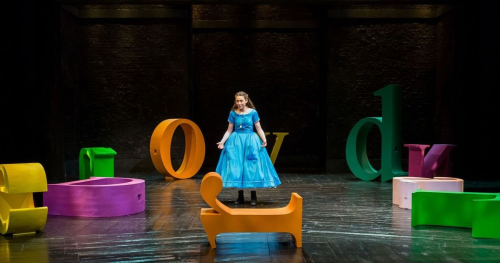
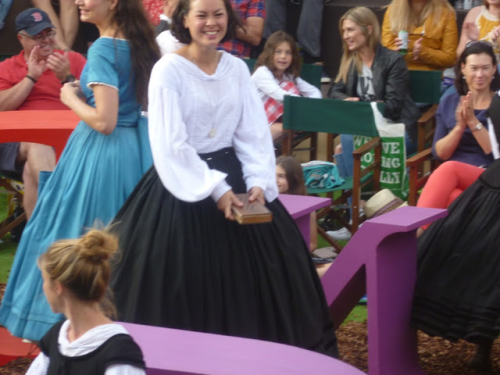
(Rabecca Birch as Alice in the World Premiere 2017 cast at Chester’s StoryHouse Theatre. Photo: Mark Carline)
This mash up of parts of both Alice tales was commissioned by the new multi million pound theatre in Chester, UK. Staged in 2017, it opened to extremely enthusiastic reviews, meeting with the same acclaim that Glyn Maxwell’s other adaptations of classic literature have also gained.
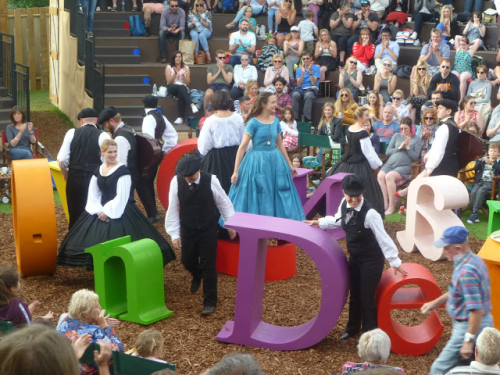
That being said, this isn’t the most easiest adaptation in the world to review. Because on first time reading, I did not have a clue what to make of it. To be clear, Maxwell’s adaptations all fall somewhere between adaptation and re-imagining, and this is no exception.
Maxwell’s overarching subplot of this version is that frightened of going to boarding school, Victorian Alicia splits herself into 2. Alice goes off to boarding school (which of course also turns out to be Wonderland) whilst Alicia stays in the real world, and grows ill. Very, very ill.
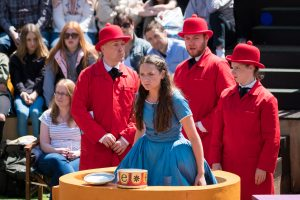
Act 1 has Alice stumbling round a Wonderland as boarding school setting, with everyone being immensely unhelpful. She ends the act so confused she turns into the Red Queen (by that, I mean the Queen of Hearts). But I couldn’t help noticing that in adaptation terms this was very, very fast paced and short.
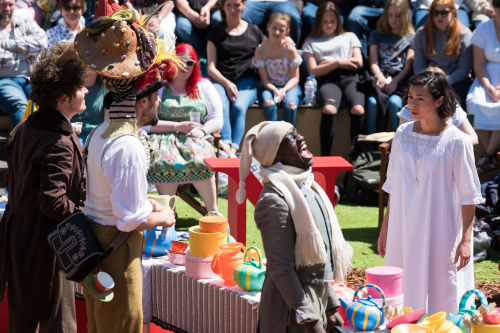
That’s because in act 2 bed-ridden Alicia tries to search for Alice via her illness induced fever dreams (yes, really!) and encounters more Wonderland/Looking-Glass residents. Particularly funny are the intensely Scottish Unicorn (of Through the Looking-Glass) and the Cheshire Cat, who fades away before he can offer Alicia any good advice. There’s also the fantastic addition of Alicia pointing out to everyone she comes across that they aren’t real.
On finding Alice, Alicia finds her raving and braying for beheadings. Turns out, she’s playing at being the Red Queen (The Queen of Hearts) because she’s lonely and everyone she’s met in Wonderland seems to despise her. Alicia convinces her to drop the act before they both face off against Alice’s greatest fear- The Jabberwock.
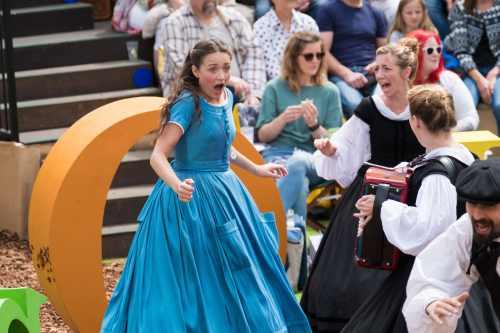
If me describing this version made no sense, reading the actual script multiplies that feeling. Maxwell seems to put parts of both Alice tales into a food blender, making his adaptation feel almost entirely like the 113 degree fever that Alicia is suffering from.
In a way, its curious that no one has ever adapted carroll’s tales as fever dreams before- because that concept works very very well in this version. Almost too well…
I also love the idea of having 2 split Alices. One in the real world, one in Wonderland. In a way, you can feel the influence of Moira Buffini’s National Theatre flop Wonder.land on this version (compare Aly and avatar Alice’s friendship with Alicia and Alice’s. Its very similar!) which is no bad thing!
I honestly hope this gets more productions in the future. It was fascinating.