"How puzzling all these changes are! I’m never sure what I’m going to be, from one minute to another! However, I’ve got back to my right size"
- Alice, Alice's adventures in Wonderland, Lewis Carroll
This
blog is kind of an essay but kind of isn’t. This
is a piece I’ve wanted to write since I read this play last
year. I don’t think I’ve ever mentioned it on this blog, but I am
an aspiring playwright aiming to write surreal/experimental plays.
Because this is an underappreciated style in theatre whenever I read
something in this genre I tend to instantly love it. This has been
the case with Big and Small.
So
um… yesterday, April 4th, Schaubühne in Berlin
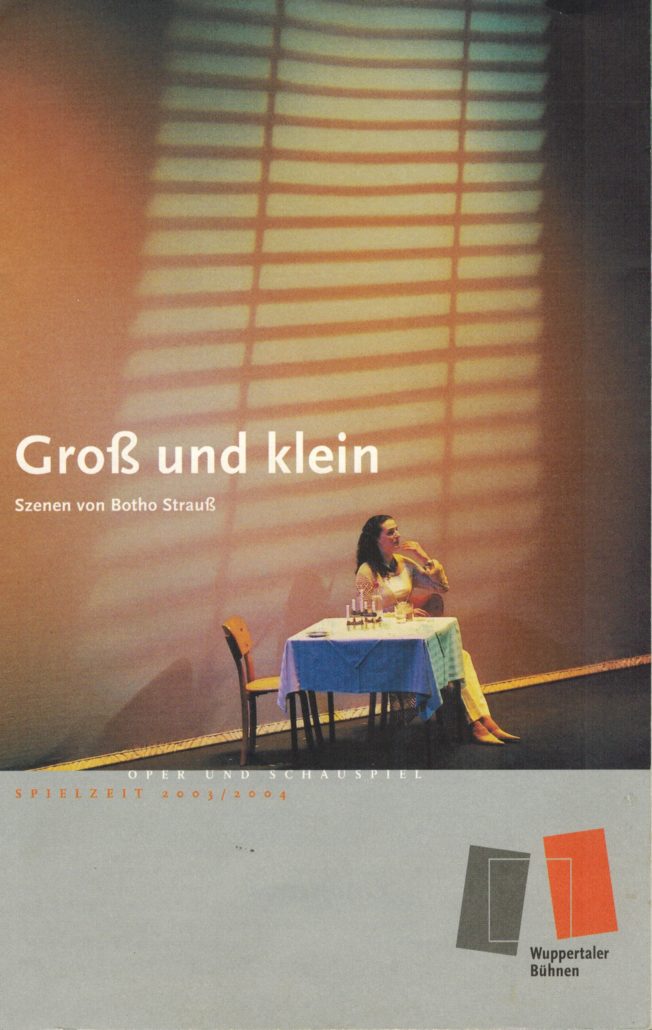
streamed Botho Stauss’s Big and Small (Groß und klein)
on their site for 24 hours. This was the original 1979 production
as broadcast in 1980 and was in German (leaving me to scramble around
reading the Anne Cattaneo English translation if the script)
The
play has subsequently had various revivals in various languages
including French, English, and most recently Spanish. There have been
4 notable English language productions so far, the last in 2012.
Any
video recording of this play is a rarity. As is seeing an actual
performance. My main experience with this play comes from an English
translation of the script. This is a real shame as honestly, this
play is fascinating, and bizarre, and yes, Carrollian.
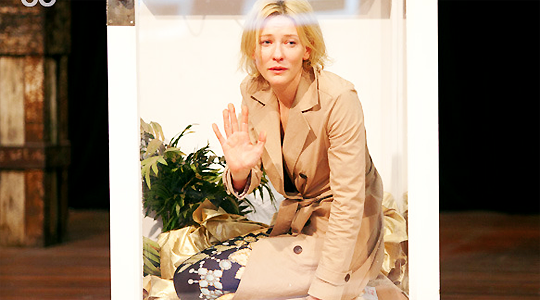
(
2008 Berliner Deutsche Theater production, Image via Der Spiegel)
"Where next in this everywhere?"
Big
and Small is essentially about a woman, Lotte’s, bizarre
experiences as she becomes more and more cut off and isolated from
family, friends, and society as a whole. After she is rejected by her
husband Paul she goes on a wirlwind journey around East and West
Germany (we’ll get to the significance of that later) Also, its
kind of Alice in Wonderland for adults (which is why I’m
writing this here)
As
a character Lotte is eternally optimistic, even as she is rejected
again and again by society and people who simply do not want her
there. Her attempts at integration become more desperate as the play
goes on.
Towards the beginning she looks in on a couple, and tries to
befriend the wife, a socialite, by convincing her that she is a fan
of her. They play a game of dress up, until the woman gets bored and
insists Lotte leave. Later on Lotte desperately calls an acquaintance
she remembers from school 20+ years ago on her intercom, who insists
she can’t stay for the night.
Lotte as an absurdist and Alice figure
There
are also many carrollian interjections. In the intercom scene Lotte
is too small for anyone in the house to really hear her. In an
earlier scene, which depicts Lotte moving into a surreal apartment,
she has to jump to reach a gigantic key which will open the door to
her new flat.
Lotte
is a postmodern protagonist, echoing protagonists in absurdism and
surrealism who are ineffectual, ordinary, and are thrown in against
often horrifyingly strange situations. She is also an adult variant
on Lewis Carroll’s Alice as Lotte carries a sense of innocence and
naivety which other protagonists in this genre lack.

Germany, politics and Isolation
The
play is also about Germany. And its also about deep isolation. At
the time of Stauss’s writing, the Berlin wall was still up and as a
result this work is often critiqued as a political/social commentary
on East and West Germans, their different cultures, and their
isolations. This critique however tends to forget Lotte’s place as
a central character and also the fragmented, deliberately
surrealistic nature of the story.

(1988 production, via Sydney Theatre Company)
Although
the places that Lotte travels to, a flat, a house, a street, a
garden, a waiting room are all familiar, they are warped by her and
others perceptions. This warping of everyday things also helps create
a sense of alienation. Nearly all the characters in this play are
either unhappy or are related to someone unhappy. They live in their
own worlds and rarely connect.
"....And in the end Paul left too."
An unreal world
Lotte’s
main experiences occur after she is rejected by her husband, Paul,
and as well as the historical background and surreal scenes there is
also a sense in Big and Small that
Lotte is not just travelling through Germany but arguably also her
own psyche. This is shown through the downright weird encounters
that she has, from the 17 year old girl in her apartment
who is too afraid to face the world outside of a tent, to her
snappish and bizarre extended family who argue about
finance, act oddly and generally ignore her.
(
2012 production, image via Geraint Lewis Photoshelter Archive)
"Don't you recognize me, Albert?"
In
fact upon re reading the segment about the family barbecue, I was struck by how
much the barbecue scene evokes Carroll’s mad tea party, right down
to the participants irritating the protagonist as much as they can.
Lotte, like Alice, leaves in disgust.
The centrepiece of the play is a scene in a phone booth where Lotte
attempts to contact Paul, then write a letter, trying to convince
herself that she is fine with his new relationship with Inge, “the
woman in the zipped up dress” who Lotte only glimpses part way
through the play. Its notable that after this scene Lotte’s
attempts to integrate with people become more delirious and frantic.
At one point she appears before a man waiting at a bus stop to
crazily tell him that she is “one of the righteous”. She also
lapses into arguments with an unseen person.
Conclusion
This
play seems ripe for revival sometime soon. After all, the last
few years politically have been polarized, with countries, friends,
family, split into opposing fractions. Big and Small
reflects societal unhappiness back at us.
Watching
Big and Small now in the current climate is an
even stranger experience, making an already weird play a thousand
times more so.
You
can sense the stillness.
NOTES
AND RESOURCES:
- The
only English translation of the script, translated by Anne Cattaneo, available in the anthology Contemporary German Plays II: T. Bernhard, P. Handke, F.X. Kroetz, B. Strauss.
- An
insightful New York Times, 1983
New york production review
- Costume
designs, Voytek, 1983 London production costume designs,
V and A archive