Monday, 13 May 2024

Notification!


 Alice in Backlands (original title: Alice Dos Anjos) is now on dailymotion with English subtitles!

Alice (Tiffanie Costa) discovers a bizarre and brilliant land where she encounters even stranger characters. However the community is under threat from a local colonel who will do anything to take the land the community relies on.

This delightful adaptation aired on ARTE1 Brazil a few months ago, after many years round festival circuits in the region. It has a cabinet of trophies to prove its worth now. For us here its most valued as being the technical first adaptation of Carroll's Alice books as a film/TV special since... 1999's NBC attempt. 

I'd say more, but really you should just go and enjoy it. This is the first of several adaptations this decade to release (if IMDB is correct fully) so we are nowhere done with Carroll and film yet :)

You can follow announcements for this film officially on instagram :)

Tuesday, 19 December 2023

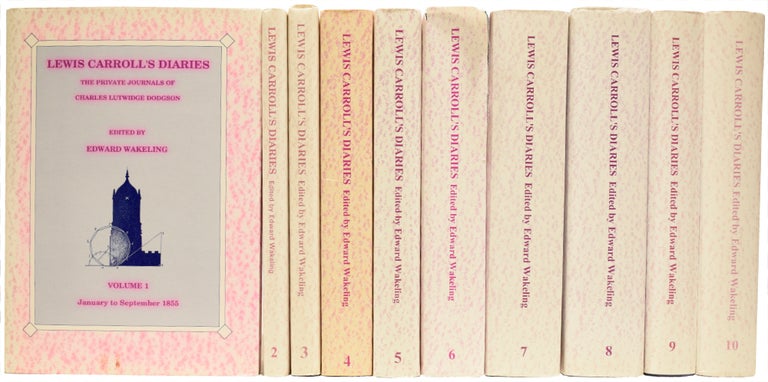
Thoughts on Charles Dodgson/Lewis Carroll's unedited diaries (1993, edited by Edward Wakeling)


(A rare complete set of the undedited diaries, photo by Harrington Books UK)

A dear friend of mine is currently undertaking work in regards to Charles Dodgson/Lewis Carroll's unedited diaries. These are the ones that are most complete and were published in the mid 1990s by the Lewis Carroll Society UK, and edited with expert footnotes by Mr Edward Wakeling. I have now had the jaw dropping oppertunity to read 4 of these. I'll explain why I called this jaw dropping later in this piece, but for now, it is worth reflecting on Mr Wakeling's sheer skill at putting together these diaries as an actual series of books, and piecing together insights that were completely lost/not known in Green's 1950s version. 

Its impossible to talk about these diaries without talking about what got lost via other people's editing. Green's edited diaries of an early era, are of course, only half the story. Green omitted, according to Karoline Leach, 50 percent of the diaries. He was handed an edited manscript, edited for content. As documented by Hagues Laibally, Dodgson's own descendants would cut out anything they deemed too "adult" in nature for this children's author to be doing.

What they found much more difficult to cope with was the plentiful evidence [....] of C. L. Dodgson's attendance at and enjoyment of what they considered as coarse performances starring young pert actresses, as well as of the favourable impression various adult female nudes produced on him: proof of such vulgar tastes looked to them far more scandalous, and they suppressed it in a much more consistent and systematic way, unaware that they were thus reinforcing and confirming the already too widespread view of 'Lewis Carroll' as a monomaniac perverse. 

 So that's any references to romance with adult ladies, and any references to "erotic" art that Dodgson seems to have enjoyed. Laibally also notes that what was omitted was:

13 % of the books C. L. Dodgson read [32 out of 242]

20 % of the plays he witnessed [139 out of 683]

65 % of the concerts he heard [79 out of 121]

53 % of the light entertainments he attended [18 out of 34]

40 % of the exhibitions he visited [87 out of 215]

and 15 % of the individual sculptures and paintings he singled out [44 out of 293]

were omitted from the first printed version of his diary, together with 199 mentions of or

judgments passed on the impersonations of actors and actresses of all ages out of 870 [about 23%]

In Wakeling's restored 1993 diaries, we see:

  • Dodgson's art and culture reviews (doesn't like wuthering heights, does like the opera Norma)
  • Day to day life details at Christ Church
  • Dodgson's growing interest in photography and writing.
  • Dodgson's friends, many of whom are adults and often are left out of his story in popular culture.
  • Dodgson's attitudes to religion. Volume 4 includes multiple prayers that have long mystified scholars. Why do these prayers appear sporadically across this volume? No one really knows. Leach and Woolf point at a potential love affairs, each with varying theories. Others have rather disingeniously, tried to claim the prayers are about Alice Liddell, who features far less in these diaries than you'd imagine.

Wakeling's 1993 diaries restore a lot of what Green left out, or rather everything in 1993 that existed (minus the cut pages in diary document, which had not been found yet) Taking into context that 1990s era, its a remarkable achievement. Made even more impressive when, upon searching newspaper archives, I found almost nothing but wall to wall myth boosting about Lewis Carroll/Charles Dodgson in newspapers in the 1990s. The climate Mr Wakeling was working in appears to have been one that was media wise openly hostile to carrollians and had long sided with the now known-as-incorrect freudian stance. 

This may or may not explain why, inexplicably in my opinion, the press and popular culture as a whole did not react to the findings in the undedited diaries in 1993 or indeed, when the project finished. The supposed, even wanted, "confession" about Alice Liddell never appeared, because it never existed. That doesn't mean at all that these diaries were not "valuable", quite the opposite! Why no one did a piece on these in a public paper is beyond me.

Unfortunately, the only negative thing I can say regarding these diaries is that they are hard to get hold of.  This is why I said that my reading of them felt jawdropping to me. They are sold exclusively via the Lewis Carroll Society UK, and exist in full in US university libaries across America. The lack of access is a punishing blow for such important evergreen evidence. I wish I could encourage everyone who's interested in Carroll or has read his works to read these diaries too. And I wish the media could have read them.

SOURCES:

BOOKS:

Leach, Karoline. In the Shadow of the Dreamchild: the myth and Reality of Lewis Carroll, Peter Owen Press, 2015. 

Wakeling, Edward, Lewis Carroll's Diaries. The Private Journals of Charles Lutwidge Dodgson, Luton: Lewis Carroll Society, 1993-2007.

PAPERS

Through A Distorting Looking-Glass: Charles Lutwidge Dodgson's artistic interests as mirrored in his nieces' edited version of his diariesBy Hugues Lebailly. 

Tuesday, 19 September 2023

Rest in peace Edward Wakeling 🕯


(Edward Wakeling with manuscript replica of one of Charles Dodgson's diaries, photo via Keithpp, circa July 2010)

Devestated to hear of the passing of perhaps the only world expert in Lewis Carroll, Edward Wakeling. Wakeling's dedication to his subject matter unearthed many key documents and his lagacy shall hopefully be of someone who changed Carroll academia forever for the better. In later years Wakeling spoke out against misreadings of Carroll in the press and media and was not afraid to correct other biographers or read new research. His openess was rare in Carroll scholarship and he showed great integrity. 

He will be sorely missed.

Saturday, 13 May 2023

Softly vanishing away: A review of the Hunting of the Snark (2023)

 Based on: the Lewis Carroll poem of the same name

Directed and adapted by: Simon Davison

Staring: Ramon Tikaram (Narrator/the Baker) Ralph Arliss (The Bellman) Tim J. Henley (the Bonnet Maker) Tom Wansey (the Butcher) Peter Daw (the Banker) Tristam Kimbrough (the Billard Marker) Nick Mellersh (the Barrister) Jose Barreto (the Boots) Bernard Myers (the Broker) Richard Ecclestone (The Baker's Uncle) Corrinne Furman (Hope) 

This UK crowdfunded film, beautifully shot with Victorian style camera lens effects, has been quite a long time coming. Originally funded far before 2020, the filming process took several years and its premiere was delayed due to the pandemic. Snark is the first out of a bulk of Carroll film adaptations in English to release this decade, with others subject to either delays or a somewhat slow move through festival circuits. In that sense, this version of Snark provides an excellent taster. Like upcoming Alices, it is shot on a fairly low budget and is far away from a “Hollywood” adaptation as possible.

For expanding a 70 page or so poem into a 90 minute film, writer and director Simon Davidson makes use of all kinds of tricks, from framing the story as occurring inside the mind of Lewis Carroll himself (more on this later) to visually representing maps, ideas, and illustrations. This second element means on first watch there is almost too much to take in, and I’d advise anyone thinking about watching this to do it twice. 


The film is packed with details and references to Carroll’s other works, the Victorian era, and mathematical and philosophical conundrums. Carrollians who are more in tune with these subjects than me will surely adore digging into the various signs and symbols and title cards the film presents its audience with. 

The cards, old Victorian organ music, slapstick, sharp angles and camera lens effects will remind you strongly of both Victorian theatre and culture. You will also be reminded of the films of art house directors Terry Gilliam and Jean Pierre Jeunet, whose unreal visual flairs and bizarre humour the film shares somewhat, but never to the point of just solely imitating either director’s style. The music, also by director Davidson, is also exceptional, waltzing between Victorian seaside organs, Carrollian poems, and carnival uneasiness. The end credits piece, mixing spoken word with several of these elements, is impeccable. You will want it on your Carrollian playlist, if you have one!


The loose story, as ever, focuses on a group of people setting off to hunt a mythical being called the Snark, with only a limited idea of what to do if they find it. This version focuses most on the Baker (played by Ramon Tikaram), promoting the character to almost lead status. This also means in terms of adaptation we see flashbacks to his childhood (not just the scene with his Uncle but several severe schoolroom memories) This version also gives him a sort of visionary role. The Barrister’s dream verses are altered in the biggest adaptational change to become about the Baker. Indeed there are multiple dream sequences throughout the film in which the Baker seems to come close to knowing his fate. Tikaram's Baker is a mix of wonder and fear, and the actor plays all sides of the character marvellously. 

The rest of the crew fit more in line with their original poem counterparts. Key standouts in the cast are the Bellman (played by Ralph Arliss) and the Butcher (played by Tom Wansey) Because this is an ensemble cast, its difficult to highlight individual actors as the overall affect means there is no weak link in the casting.  This version also adds another character, although she a dancer and so is not given any dialogue. A personification of Hope (played by Corrinne Furman) exists on Snark island and her appearances and disappearances indicate the mood of the crew, and often the direction of the narrative. 


What makes this version stand out from other Snarks the most is the strange meta twist that occurs halfway through. We are told at the beginning by a narrator, that this will not just be an adaptation, but a “journey into the mind of Lewis Carroll”. What does that mean for the viewer exactly? It means that as well as the poem, we get tiny flashes here and there to the reality of the situation for the poem characters. The Baker, in one of his dreams, catches a glimpse of a shadowy Carroll (played by Avon Flower) in an office which is likely to represent Christ Church. Alice, away from her dream adventures, runs through a corridor like a ghost as Carroll no longer needs her as a character. 

Unfortunately, sometimes this strand of the film gives way to rather ill thought out (in my opinion) darker ideas: why does a version of Gertrude Chataway look sadly at Carroll as he passes her on the beach? Is the grief Carroll is suffering with regarding a death in the family affecting the Snark poem? None of these questions are answered, and it is extremely difficult to tell how the film wishes us to feel about this fictionalisation of Carroll. I found this element occasionally difficult to swallow. I can’t know for sure, but this part may unintentionally be playing into mythic ideas, seeing Carroll as a shadowy figure or even a figure of harm (depending if you see the film’s ending as a result of Carroll’s grief being taken out on the poem characters) A friend of mine, whom I watched this film with, also had a similar reaction. It is, however, entirely possible to watch this film and come away with a totally different interpretation of its version of Carroll, and I'm well aware that my interpretation may be entirely false or not what the filmmakers intended! 

Overall the film works extremely well as a version of Snark on film, and despite my misgivings with how Carroll himself is incorporated into the narrative, the strength of the Snark island scenes and adaptation balance out any slight disquiet you may feel towards how Carroll is portrayed. I would still recommend it highly. Adapting a near un film-able poem with all the whimsy, darkness, and humour needed is a tough task, and this film mostly succeeds. 

The Hunting of the Snark 2023 is currently available to watch in the UK and US via Amazon video.