VOTE HERE!
Your voting options are:
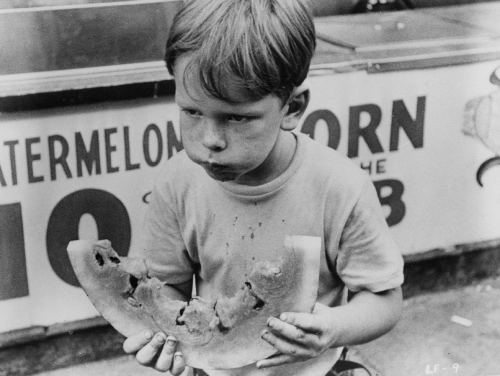
Little Fugitive (1952)
Early American film dating from the 50s.
A seven year old boy, convinced he has killed his brother, runs away and gets stuck in the Wonderland of Corney Island.
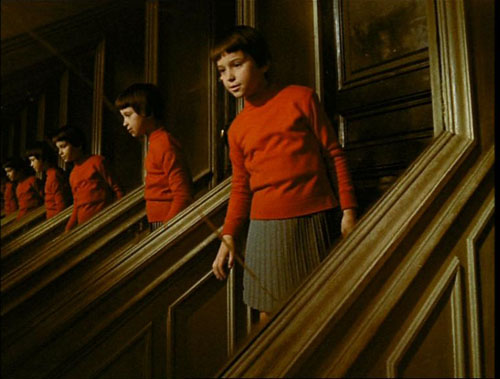 Zazie Dans Le Metro (1960)
Art house surrealist comedy by Louis Malle. Based on the Raymond Queneau novella.
Zazie Dans Le Metro (1960)
Art house surrealist comedy by Louis Malle. Based on the Raymond Queneau novella.
Curious Zazie wants to see the Parisian metro, but its closed. So she embarks on a series of odd misadventures around Paris instead.
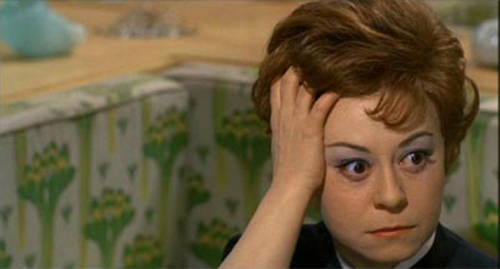
Julliette of the Spirits (1965)
Arthouse fantasy film by Federico Fellini.
Prim housewife Juliette begins to suspect that her husband is having an affair, and subsequently tumbles into a tangled web of visions, dreams and memories, guided by mysterious people and forces.
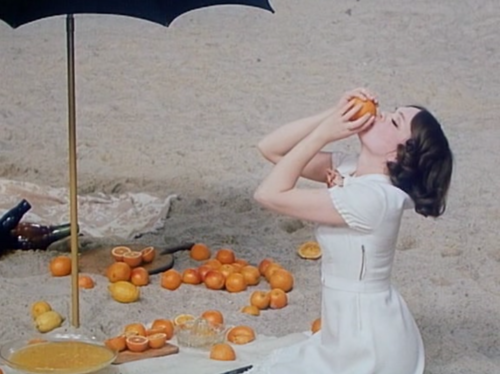 Fruit of Paradise (1970)
Czech feminist revisioning of the “Adam and Eve” tale, by the same director as Daisies. Banned until 1980 in the Czech Republic.
Eva and her husband live happily in a surreal sanitarium, until one day Eva becomes curious about a mysterious man in red.
 Case for a New Hangman (1970)
Described as part Swift, part carroll, part Kafka.
Case for a New Hangman (1970)
Described as part Swift, part carroll, part Kafka.
After accidentally killing a hare in a waistcoat whilst driving, a man named Gulliver stumbles into a bizarre place on another side of a tunnel where people obey strange laws such as constantly keeping their mouths shut.
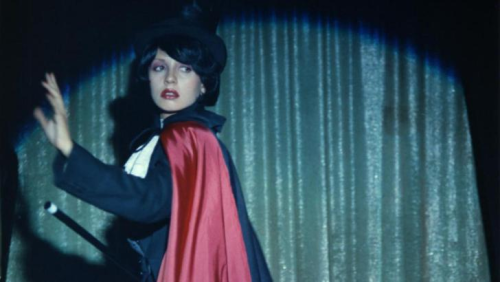 DOUBLE BILL: Celine and Julie Go Boating (1974) + Desperately Seeking Susan (1985)
Two films with a close storyline..
DOUBLE BILL: Celine and Julie Go Boating (1974) + Desperately Seeking Susan (1985)
Two films with a close storyline..
In the three hour long (!!) Celine and Julie go Boating (1974) Celine and Julie meet and soon start sharing the same identities as well as an intense imagination. Soon, thanks to a magic sweet, they become twin Alices as they become participants in a surreal melodrama in a mysterious country house.
In Desperately Seeking Susan (1985) a suburban housewife, seeking escape from her life, suffers amnesia is mistaken for a free-spirited woman named Susan.
These films are paired together because one is basically a remake of the other.
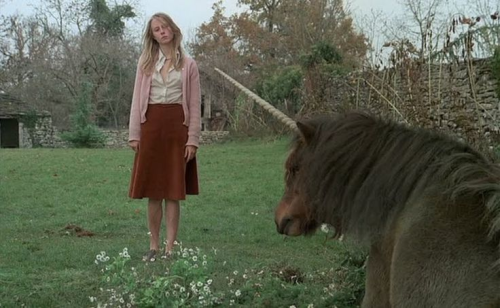
DOUBLE BILL: Black Moon (1975) + Alice or the last Escapade (1977)
Extremely weird arthouse films with the same plot: both are about young women trapped in unreal, carrollian places near country houses.
Curiouser and curiouser!
In Black Moon (1975), Lily flees a war between men and women and becomes entangled in a strange secret society in a country house.
In Alice or the Last Escapade (1977) , A woman in her mid 20s named Alice Carol flees her boring domestic life and becomes entrapped in the strange society of a country house, where time works differently and no one will let her leave.
These films are paired together because they're essentially the same movie.
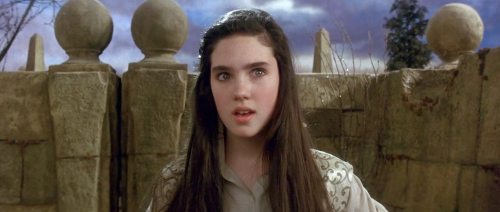 DOUBLE BILL: Labyrinth (1986) + Mirrormask (2005)
Films both from the Jim Henderson production team…
In Labyrinth (1986), Sarah gives her brother to the goblin king- and instantly regrets it. To get him back, she’ll have to traverse a labyrinth inhabited by a talking caterpillar, goblins and other strange beings.
In Mirrormask (2005), teenager Helena gets trapped in a dreamworld based on her own fantastical drawings after her mother falls ill.
These films are paired together because one is meant to be the “spiritual successor” of the other.
 Tideland (2006)
Adaptation of Mitch Cullin's disturbing 2000s novella, directed by Terry Gilliam.
Jeliza-Rose’s parents are irresponsible drug addicts. When her mother dies her father moves her to the Texan wilderness. Soon she is all alone with only her four barbie doll heads (each with their own personalities) for company. But her imagination soon makes up for the hardship of her childhood, and she slowly begins to sink into a darkly hallucinatory fantasy.
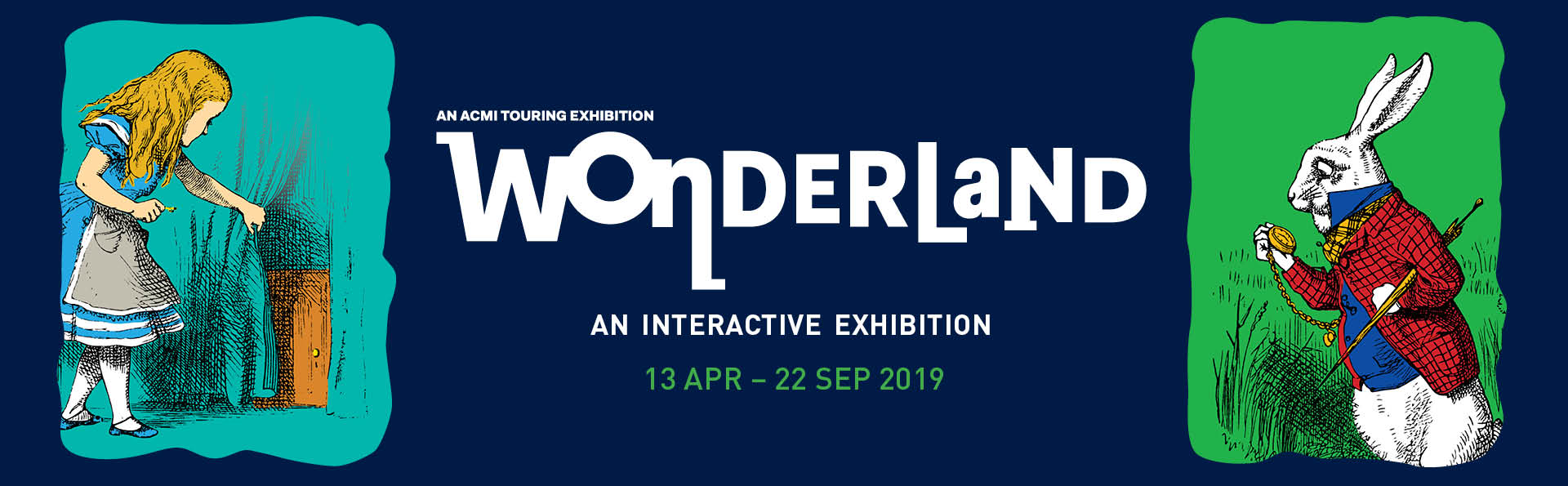
So ACMI's massive retrospective on Carroll, Alice and culture opened in Singapore on Saturday on its first tour stop.
As I hoped, there is an extra attached:

Alice is everywhere film festival
Not what you might think.
This one is a bit complex: the 2018 Australian premiere also had a film festival with this title, but unfortunately the Singapore version does not have the depth of the 2018 ACMI fest.
Instead of showing films inspired by Carroll's books, Singapore's Alice is Everywhere offers up 3 versions of Alice. These are 1951, 1933 and 1966 BBC.
They are only on for three weeks starting now.
Whilst this is always extremely welcome, it feels a little weak in comparison with the original ACMI festival which had 10 + films, many rarities.
I have no idea why only 3 films are being shown. I also have no idea if this Alice is Everywhere will become the standard touring version..... I hope not.
It was terribly hot. I lay in the shade of a tree, feeling quite limp. I had put down my handkerchief on the grass: I reached out for it to fan myself when suddenly it called out, ‘Miaow!’ Here was a pretty puzzle. I looked and found that it wasn’t a handkerchief any longer. It had become a plump ginger cat with bushy whiskers, staring at me in the boldest way.
from HaJaBaRaLa (A topsy-turvy tale)
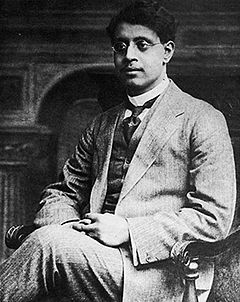
Born in Bengal, India in 1887, Saukmar Ray’s nonsense works would go on to shape the fabric on Bengali culture, being continually referenced and parodied. in many ways the Ray-Carroll comparison is apt, as both writers wrote fledgling works for family magazines. In the case of Ray, it was one that he and his brother Subinay Ray helped set up through their father’s publishing firm. The majority of Ray’s nonsense work was written for “Sandesh” over an 8 year period. The most famous of these works being the collection of satires/poems “Abol Tabol” and the Carrollian “HaJaBaRaLa (A topsy-turvy tale)“ in which a young child gets lost in a bizarre world after following a handkerchief which has turned into an impertinent cat.
Despite his work being cultural currency in India, sadly essays and such in the western world seem to be lacking… which I find a little odd for someone whose work is considered an equivalent and equal to Carroll.
Both Abol Tabol and Hajabarala have been translated into English by Oxford University Press.
Excerpts and a better overview here.
1987 Documentary here.

 CAN BE HEARD: HERE (LIBRETTO HERE, YOU WILL NEED IT)
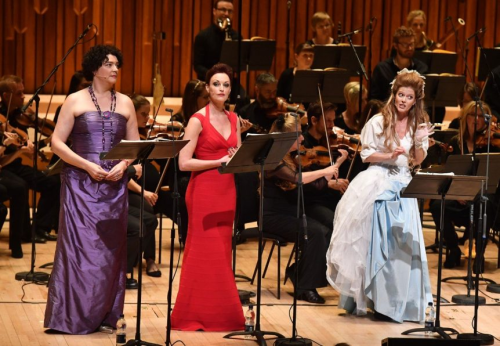
This 2016 opera by Gerald Barry covers the majority of both Alice books (when I say majority I mean most of the major Wonderland scenes.. then the entirety of Looking-Glass from live flowers onwards)
The title is Alice’s adventures Underground and its a total misnomer. Not only has it got nothing to do with Carroll’s manuscript original, as I’ve explained above it also adapts the majority of both novels.
Its incredibly fast paced and as a result, hectic, surreal and very dreamlike. Unlike other versions there appears to be no transitions between scenes. So every scene starts and ends incredibly abruptly.
I like this approach a lot.
Barbra Hannigan plays the role of Alice and is actually really convincing as a seven and a half year old. The characterisation of Alice in this version is adorable, the bizarre singing style that Barry’s singers have to push themselves to really shows. Alice sounds squeaky and in spoken parts, earnestly curious.
All the other characters of both books are split between 6 singers, Hilary Summers, Allison Cook, Allan Clayton, Peter Tantsits, Mark Stone and Joshua Bloom. All match up to the enormously complex task admirably.
The libretto is also a lot of fun, although at times its hard to hear what’s being sung. I’m very glad a typed out Libretto was available. It makes it easier to understand when you can follow along!
The croquet match is a crazy cacophony of singers singing various scales and things in different languages to match Alice’s confusion over the game. The lobster Quadrille is sung by the entire group of singers in a distorted round. Jabberwocky is recited multiple times in different languages. Overall everything is incredibly inventive and quite possibly not like any opera you’ve ever heard before.