Wednesday, 24 April 2019

ARCHIVE POST: Speaking Likenesses (Flora’s story) by Christina Rossetti

image

Please note: this post covers only 1 of the stories in Speaking Likenesses. Although the last is also cited to have Carroll-esque inflections, I only feel that Flora’s story is Carrollian enough to be talked about.

Can be read: Via archive.org as part of the public domain. 

Written by Dodgson’s contemporary, Rossetti, Speaking Likenesses is an anthology of several loosely linked stories as told by an aging mother to her three girls. I’m going to disagree with many studies of this novella and instead go with the view that Rossetti was not using these stories to criticize or mock Dodgson’s Alice tales. If anything, Rossetti’s stories also mock the inane moralism of children’s tales similarly to Carroll, albeit in a less restrained fashion. Evidence of this can be seen in the silly, trivial questions that the three sisters ask the mother, and the mother’s often overzealous use of moralising in her tales.

With that out of the way, let’s take a look at the 2nd tale of the three, Flora’s story. Flora’s character has several Alice-based personality features. Namely her unshakable sense of curiosity and her ability to keep her sense about her during her often surreal, and in this case, rather unpleasant encounters. Although the mother when telling the story points to Flora’s imperious nature when trying to control her friends after they fight at her birthday, the mother fails to understand that Flora’s temper giving way to anger over her friends would only be natural. It’s not like she hasn’t tried to stop her friends from fighting. Overall despite her flaws Flora is generally conveyed as a nicer child than the mother’s view paints her as. 

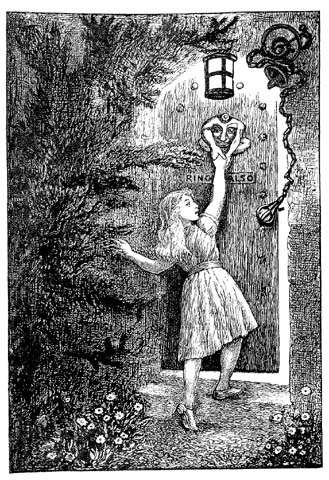
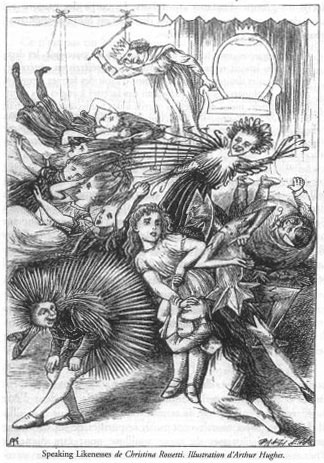
 Carroll’s novels often play upon the uncanny via the Duchess and Queen of Hearts in Wonderland, and the train passengers, sheep and mutton meal in Looking-Glass. But their vague uneasiness is not brought to the centre. Alice moves on, barely dwelling on each encounter. Even the Queen of Hearts is just a bit player of a larger narrative. In Rossetti’s likenesses, Flora may go through a door but she does not end up in a world of wonder by any sense. Through the door is a warped version of a birthday party, where each uncanny resident is downright horrendous towards Flora.
image


Although the curious mirrored walls and anthropomorphic chairs recall Carroll, they are only used as operators to deny Flora of any joy. A sort of inverse form of Carrollian writing then. 

Flora is denied food by the self-proclaimed Birthday Queen, and then subjected to having pins thrown at her as a party game. Although Carroll’s Alice may suffer threats of beheading or disappearing altogether, she is never really physically harmed. But Flora very much is.


And how much does Flora learn from her experience? Other than never to fall asleep in the garden ever again? Or never to go through any unusual doors? 

The moralistic mother tells us as readers it’s for her own good. That in the future, Flora will become a proper Victorian lady because of this dream. But this statement rings entirely false. And yes, that’s the point. 

In mocking the Mother character, Rossetti aims all her scorn at moralistic adults who enforce strict rules on children and pointless lessons for their supposed own good. 

Can't help but wonder if Rosetti was inspired by Carroll's Duchess. 

Everything has a moral, if only you can find it.

Indeed! 

Tuesday, 23 April 2019

ARCHIVE POST: Alice Film Opinion: Hallmark’s Alice in Wonderland (1999)

Alice in Wonderland - tina-majorino Screencap

So this is my re-evaluation of the 1999 adaptation which was a Hallmark production and was shown on channel 4 here in the UK.

I did not like this version at all when I first saw it, but after the catastrophies of 2010 and 2016, it is fair to say it has grown on me a bit more. For one, this is an adaptation of Carroll's books, a very flawed one yes, but 2010 and 2016 aren't even that, so I should be a bit more greatful! 

 So this is me attempting to right a few wrongs.

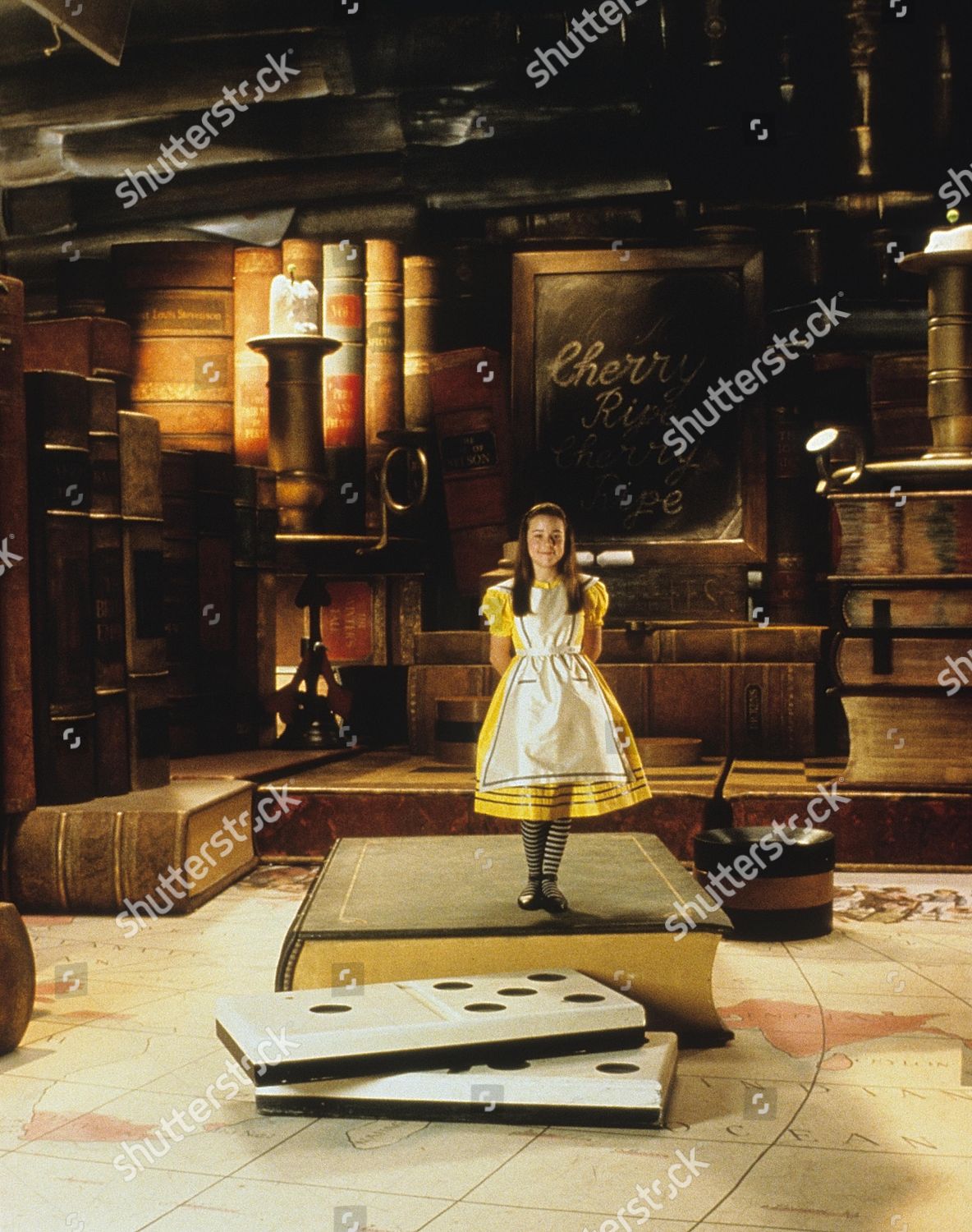
First off, the opening sequence is really unusual, dark, and I love it. The film opens with a massive metronome swinging back and forth. A very nervous Alice (played by Tina Majorino) appears and begins to sing “Cherry Ripe” a song which actually dates to the Victorian era. Fear overcomes Alice and she sings off key. She suddenly finds herself staring into a mirror as her grandmother is brushing her hair, humming aforementioned song.

Alice in Wonderland - tina-majorino Screencap

After that surprisingly dark opening the moral of the story is introduced. Unfortunately Alice has to sing later in front of strangers at her parents party, something that she is horrified at. So stepping out of the house and in a attempt to run away from everything she inevitably discovers Wonderland. 

It is in the moral that the major flaw of this film sits upon. The novels mocked morals, particularly in the character of the Duchess who thinks that everything has a moral. 


`You’re thinking about something, my dear, and that makes you forget to talk. I can’t tell you just now what the moral of that is, but I shall remember it in a bit.’
`Perhaps it hasn’t one,’ Alice ventured to remark.


Unlike say, the 1985 film which also has a moral, I felt that this one sticks out badly. I would be fine with the moral if it was in the background but unfortunately every so often the film will bring it up. The characters in Wonderland actively tell Alice that they’re there to boost her confidence and to me this feels unnatural. It also takes a bit of the weirdness away because we know that the only reason Wonderland exists in this version is to help a dilemma.

The other major problem with this version is its length. After the mock turtle and gryphon scene the film takes a odd, and in my opinion, unnecessary detour into the second novel, “Through the Looking-Glass” where it goes through several chapters very quickly. I don’t really get the need for this. It just makes the film overly long.

Away from the negatives, there are great, great moments in this film. For example, the scene where Alice falls into wonderland is just stunning. The visual look of it all is gorgeous. There’s also the fantastic moment when Alice crosses into the Queen of Hearts’s garden, she walks through a mirror door and switches places with herself. How amazing is that? Oh did I mention the music? Its just beautiful. Richard Hartley’s score is to die for.

Lets talk about the performances, and first up, I have a bit of a confession to make. I don’t get Tina Majorino’s Alice at all. Maybe its because her interpretation is so far away from Carroll’s Alice, maybe I just don’t like her acting style. I have to like the portrayal of Alice and unfortunately, and although it pains me to say this, I just can’t like this interpretation.

image


On the positive side, three words: Elizabeth Springs, duchess. “MORE PEPPER!” The duchess in this version is one of the very best interpretations, completely mad and hilarious, the pig and pepper scene is one of the film’s best highlights with Springs and Shelia Hancock as the cook hamming it up like mad. The cook later steals the show in the trial scene with an unexpected Oxford reference!

Martin Short as the Hatter delivers a solid performance, even if I can’t stand the song he sings, “Auntie’s wooden leg”. Miranda Richardson is the Queen of Hearts. Think Queenie from Blackadder 2 doing Carroll and you’re somewhere near the ball park, she’s great, if not very threatening.

Alice in Wonderland - tina-majorino Screencap

If you watch this with a Carrollian eye you will notice several references to things that are in the books. For example when Alice falls down the rabbit hole we see a goldfish in a bowl (possibly a reference to the “incident of the goldfish” a comment made by Carroll in the trial scene in the first book) and chess pieces (referencing the second book). In the opening credits toy versions of Tweedle-Dum and dee stand in front of a looking-glass, a reference to the second novel. There are lots of throwaway references and I love how many they managed to squeeze in.

Overall, this version is an extremely mixed bag that differs between great and questionable attributes. Its one of those films I can admire in places, but due to its flaws, it often feels like a fascinating, if failed, experiment.

1999 is officially 20 years old!


Alice In Wonderland - 1999

(Press photo by Shutterstock

1999 aired on NBC/Channel 4 20 years ago today! (this is according to IMDB... so actual dates may vary) 

Whilst it is by no means my favourite adaptation (its actually one of my least...) it is still an adaptation of Carroll's novels.

Something you can't say about the other 2 Alice films which followed in the 2010s (I'm still a bit bitter, sorry!) 

How To Survive 2017’s Flash Drought | StorageSwiss.com - The Home of Storage Switzerland

On a slightly sad note, we have officially entered adaptation drought territory... there has not been a film or TV version adapting Carroll's novels for 20 years (unless you count livestreams of the Chin opera or Wheeldon ballet)

Considering the only projects on the horizon are Come Away, Dorothy and Alice and potentially a Looking Glass Wars film, safe to say we might hit 25 years with no new adaptation quite safely....

Ugh! 


Wednesday, 17 April 2019

Down the Rabbit Hole Project: Vote for this year's films!


image


VOTE HERE

Your voting options are:

image

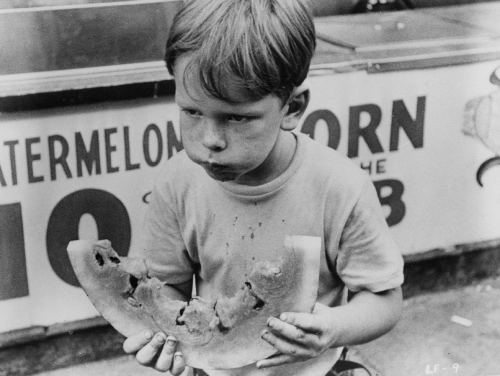
Little Fugitive (1952)

Early American film dating from the 50s. 

A seven year old boy, convinced he has killed his brother, runs away and gets stuck in the Wonderland of Corney Island. 

image

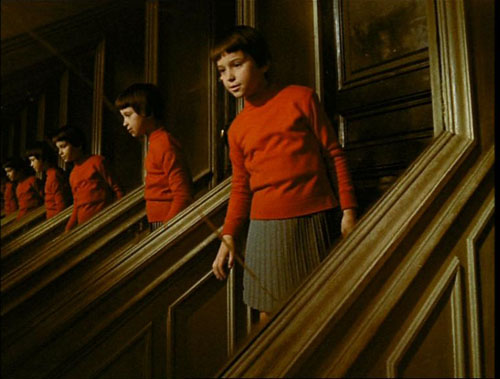
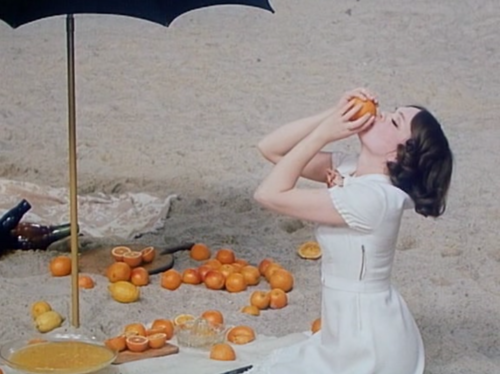
Zazie Dans Le Metro (1960)

Art house surrealist comedy by Louis Malle. Based on the Raymond Queneau novella. 

Curious Zazie wants to see the Parisian metro, but its closed. So she embarks on a series of odd misadventures around Paris instead.

image

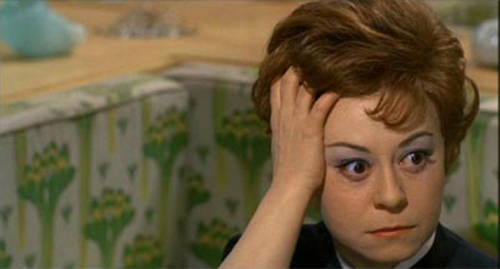
Julliette of the Spirits (1965)

Arthouse fantasy film by Federico Fellini. 

Prim housewife Juliette begins to suspect that her husband is having an affair, and subsequently tumbles into a tangled web of visions, dreams and memories, guided by mysterious people and forces. 

image

Fruit of Paradise (1970) 

Czech feminist revisioning of the “Adam and Eve” tale, by the same director as Daisies. Banned until 1980 in the Czech Republic. 

Eva and her husband live happily in a surreal sanitarium, until one day Eva becomes curious about a mysterious man in red.

Image result for Case for a new hangman 1970

Case for a New Hangman (1970)

Described as part Swift, part carroll, part Kafka.

After accidentally killing a hare in a waistcoat whilst driving, a man named Gulliver stumbles into a bizarre place on another side of a tunnel where people obey strange laws such as constantly keeping their mouths shut.

image

DOUBLE BILL: Celine and Julie Go Boating (1974) + Desperately Seeking Susan (1985)

Two films with a close storyline.. 

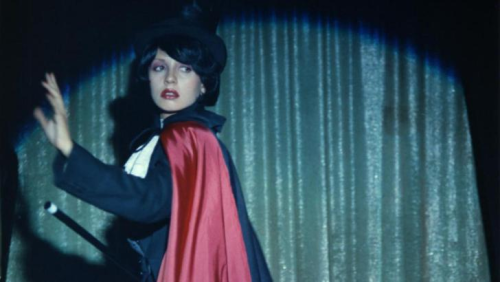
In the three hour long (!!) Celine and Julie go Boating (1974) Celine and Julie meet and soon start sharing the same identities as well as an intense imagination. Soon, thanks to a magic sweet, they become twin Alices as they become participants in a surreal melodrama in a mysterious country house. 

In Desperately Seeking Susan (1985) a suburban housewife, seeking escape from her life, suffers amnesia is mistaken for a free-spirited woman named Susan.

These films are paired together because one is basically a remake of the other.

image

DOUBLE BILL: Black Moon (1975) + Alice or the last Escapade (1977)

Extremely weird arthouse films with the same plot: both are about young women trapped in unreal, carrollian places near country houses. 

Curiouser and curiouser! 

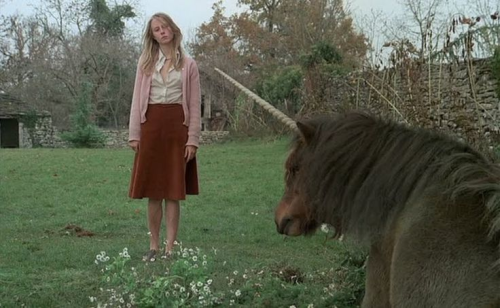
In Black Moon (1975), Lily flees a war between men and women and becomes entangled in a strange secret society in a country house.

In Alice or the Last Escapade (1977) , A woman in her mid 20s named Alice Carol flees her boring domestic life and becomes entrapped in the strange society of a country house, where time works differently and no one will let her leave.

These films are paired together because they're essentially the same movie.

image

DOUBLE BILL: Labyrinth (1986) + Mirrormask (2005)

 Films both from the Jim Henderson production team…

In Labyrinth (1986), Sarah gives her brother to the goblin king- and instantly regrets it. To get him back, she’ll have to traverse a labyrinth inhabited by a talking caterpillar, goblins and other strange beings.

In Mirrormask (2005), teenager Helena gets trapped in a dreamworld based on her own fantastical drawings after her mother falls ill. 

These films are paired together because one is meant to be the “spiritual successor” of the other.

Tideland - 2 Flash Games


Tideland (2006) 

Adaptation of Mitch Cullin's disturbing 2000s novella, directed by Terry Gilliam. 

Jeliza-Rose’s parents are irresponsible drug addicts. When her mother dies her father moves her to the Texan wilderness. Soon she is all alone with only her four barbie doll heads (each with their own personalities) for company. But her imagination soon makes up for the hardship of her childhood, and she slowly begins to sink into a darkly hallucinatory fantasy.