Wednesday, 24 April 2019

ARCHIVE POST: Down the Rabbit Hole Project: Pan’s Labyrinth (2006)

image

ARCHIVAL NOTE: VOTING FOR THE 2019 PROJECT IS NOW OPEN! 

MAJOR SPOILERS AHEAD.

ALSO, OBVIOUS EMPHASIS ON THE FANTASY PARTS OF THIS FILM, DESPITE HOW WELL MADE THE CIVIL WAR PLOTS ARE IN THIS FILM, I CAN’T REALLY TALK ABOUT THEM HERE … SORRY… 
image

Pan’s Labyrinth is both a dark deconstruction of the down the rabbit hole trope and a warning on the corruption and disregard for humanity fascism brings. The film is one of a few examples (along with Valerie and her Week of Wonders) of how the down the rabbit hole trope can be subverted and deconstructed for an adult audience.

12 year old Ofelia moves with her pregnant mother to a house inhabited by the monstrous captain Vidal, who spends his time tracking down any dissenters to the new fascist regime. Ofelia buries herself in books, and whilst exploring a stone labyrinth, encounters a faun who claims she is the lost princess of the underworld. Ofelia has three grizzly tasks to complete if she wants to leave the real world behind. All the while the situation at home only gets more fraught and horrifying.
image

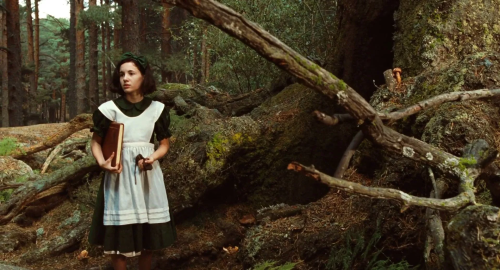
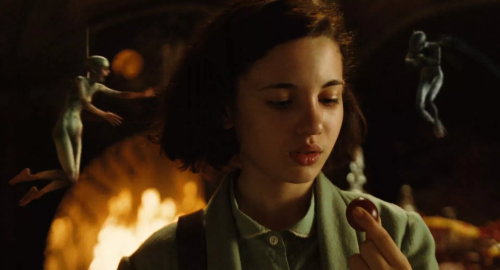
Whilst Ofelia is quickly identified as an Alice archetype by default, (the green dress and white pinafore she wears before the first task making this clear), what differentiates her from other protagonists I’ve looked at for this project is her willingness to escape. For Ofelia, living anywhere but home is desirable.
image

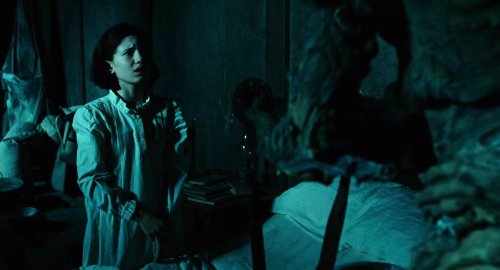
After the faun angrily comes to the conclusion that she has failed the second task due to giving into hunger for food she begs him with all her might for another chance. Most protagonists of these films and the trope codifier, Carroll’s Alice, unwittingly stumble into their lands or encounters and attempt to return home or back to some kind of normality. Ofelia meanwhile wants more than anything to leave her current circumstances behind.
image

And although Ofelia does encounter animals and creatures (mainly mythological) a far darker tone is struck than a typical rabbit hole film, partly this is due to its adult audience but also due to its various plot strands regarding the brutal civil war.  Ofelia’s trials have a habit of mirroring her harsh surroundings such as when Vidal starves the household, and Ofelia eats in the Pale Man’s realm, despite warnings from the faun.

Unlike other films of this genre, this mirroring gives Pan's Labyrinth an almost allegorical type resonance, and there have already been several high profile essays by scholars linking the film with its historical climate. 
image

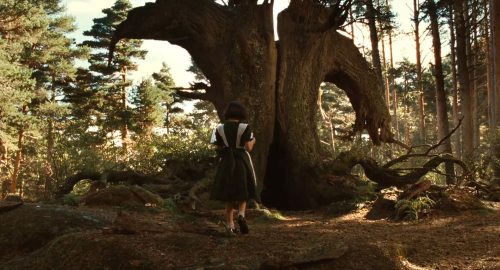
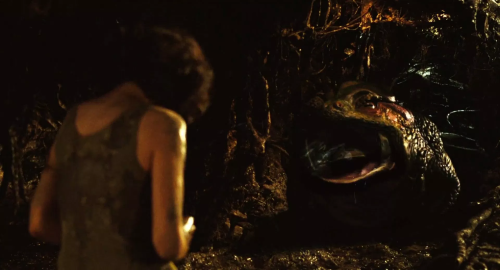
Ofelia’s decent into a tree to retrieve a key from an old toad is Alice like in text but not tone. Despite Ofelia’s assertions that she isn’t afraid, as an audience we see her vulnerability as well as bravery in this scene. The toad is the polar opposite of Carroll’s frog footman, instead of being bumbling and comedic, the amphibian Ofelia encounters is selfish, covetous and gluttonous. Ofelia gains the key by tricking the animal through offering mud as food. In a way, this scene is a similar to but offers a far darker take on the scene in Spirited Away (2002) where Chihiro gives No-Face medicine. When Ofelia crawls back out, key in hand, she finds her “Alice” dress has been forever ruined by the trees.
image

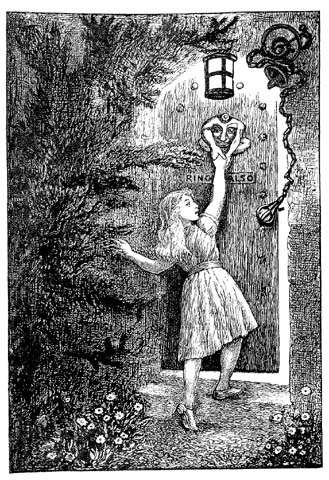
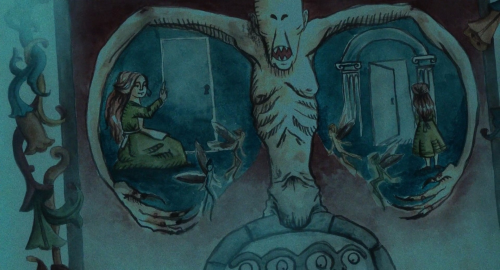
Similarly for the second task Carrollian plot points are set up then subverted. Ofelia is given a piece of chalk by the fawn and the book of crossroads, which gives her details on the pale man’s realm (the illustration again references Carroll by the use of a young girl in an apron dress drawing a door).
image

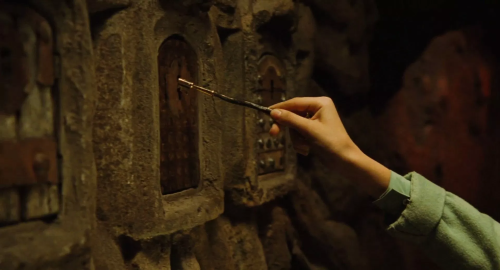
 Ofelia follows the instructions and crawls through a door to the hall of the pale man’s realm, where she takes a key and has to put it in the correct lock. This situation recalls Alice’s trials in Wonderland’s hall of doors:

a tiny golden key, and Alice’s first thought was that it might belong to one of the doors of the hall; but, alas! either the locks were too large, or the key was too small, but at any rate it would not open any of them. 

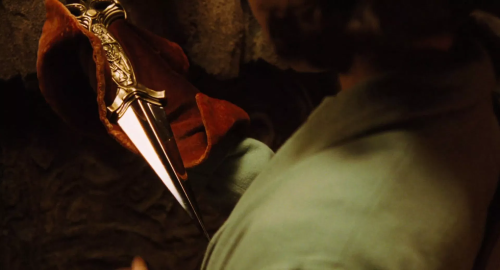
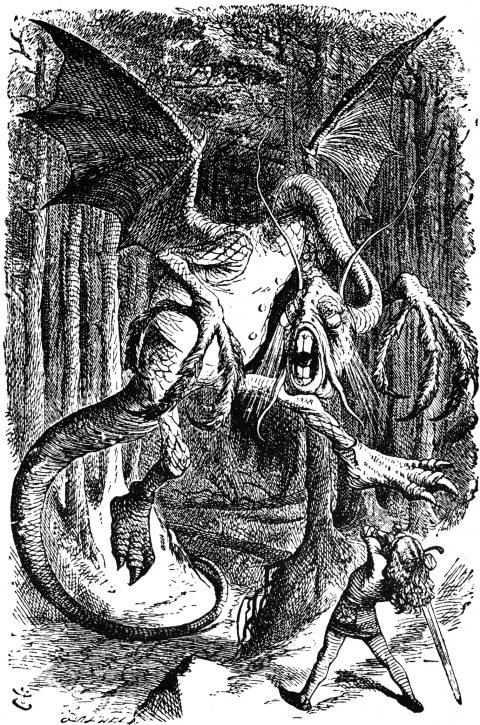
Yet Ofelia once again is in a far more perilous situation. At the other end of the hall is the child eating pale man, and the cupboard she eventually opens reveals a sharp knife, resembling illustrations of the Vorpal sword from Carroll’s poem from Through the Looking-Glass, The Jabberwocky. This is later used to try and spill the blood of an innocent in the third task.
imageimage

Overall Pan’s Labyrinth provides one of the finest examples of making a down the rabbit hole archetypal film for an older audience. By subverting and deconstructing the tropes audiences know, this film carves out a unique, if often dark path.

STRAY NOTES


  • A musical version is apparently in development and will premiere soon.

ARCHIVE POST: Speaking Likenesses (Flora’s story) by Christina Rossetti

image

Please note: this post covers only 1 of the stories in Speaking Likenesses. Although the last is also cited to have Carroll-esque inflections, I only feel that Flora’s story is Carrollian enough to be talked about.

Can be read: Via archive.org as part of the public domain. 

Written by Dodgson’s contemporary, Rossetti, Speaking Likenesses is an anthology of several loosely linked stories as told by an aging mother to her three girls. I’m going to disagree with many studies of this novella and instead go with the view that Rossetti was not using these stories to criticize or mock Dodgson’s Alice tales. If anything, Rossetti’s stories also mock the inane moralism of children’s tales similarly to Carroll, albeit in a less restrained fashion. Evidence of this can be seen in the silly, trivial questions that the three sisters ask the mother, and the mother’s often overzealous use of moralising in her tales.

With that out of the way, let’s take a look at the 2nd tale of the three, Flora’s story. Flora’s character has several Alice-based personality features. Namely her unshakable sense of curiosity and her ability to keep her sense about her during her often surreal, and in this case, rather unpleasant encounters. Although the mother when telling the story points to Flora’s imperious nature when trying to control her friends after they fight at her birthday, the mother fails to understand that Flora’s temper giving way to anger over her friends would only be natural. It’s not like she hasn’t tried to stop her friends from fighting. Overall despite her flaws Flora is generally conveyed as a nicer child than the mother’s view paints her as. 

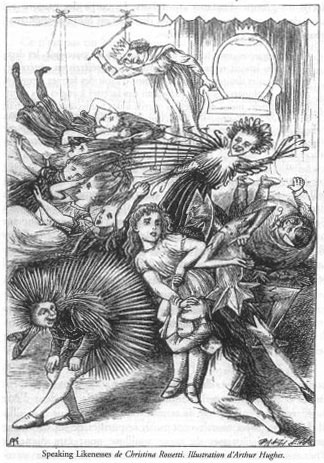
 Carroll’s novels often play upon the uncanny via the Duchess and Queen of Hearts in Wonderland, and the train passengers, sheep and mutton meal in Looking-Glass. But their vague uneasiness is not brought to the centre. Alice moves on, barely dwelling on each encounter. Even the Queen of Hearts is just a bit player of a larger narrative. In Rossetti’s likenesses, Flora may go through a door but she does not end up in a world of wonder by any sense. Through the door is a warped version of a birthday party, where each uncanny resident is downright horrendous towards Flora.

image


Although the curious mirrored walls and anthropomorphic chairs recall Carroll, they are only used as operators to deny Flora of any joy. A sort of inverse form of Carrollian writing then. 

Flora is denied food by the self-proclaimed Birthday Queen, and then subjected to having pins thrown at her as a party game. Although Carroll’s Alice may suffer threats of beheading or disappearing altogether, she is never really physically harmed. But Flora very much is.


And how much does Flora learn from her experience? Other than never to fall asleep in the garden ever again? Or never to go through any unusual doors? 

The moralistic mother tells us as readers it’s for her own good. That in the future, Flora will become a proper Victorian lady because of this dream. But this statement rings entirely false. And yes, that’s the point. 

In mocking the Mother character, Rossetti aims all her scorn at moralistic adults who enforce strict rules on children and pointless lessons for their supposed own good. 

Can't help but wonder if Rosetti was inspired by Carroll's Duchess. 

Everything has a moral, if only you can find it.

Indeed! 

Tuesday, 23 April 2019

ARCHIVE POST: Alice Film Opinion: Hallmark’s Alice in Wonderland (1999)

Alice in Wonderland - tina-majorino Screencap

So this is my re-evaluation of the 1999 adaptation which was a Hallmark production and was shown on channel 4 here in the UK.

I did not like this version at all when I first saw it, but after the catastrophies of 2010 and 2016, it is fair to say it has grown on me a bit more. For one, this is an adaptation of Carroll's books, a very flawed one yes, but 2010 and 2016 aren't even that, so I should be a bit more greatful! 

 So this is me attempting to right a few wrongs.

First off, the opening sequence is really unusual, dark, and I love it. The film opens with a massive metronome swinging back and forth. A very nervous Alice (played by Tina Majorino) appears and begins to sing “Cherry Ripe” a song which actually dates to the Victorian era. Fear overcomes Alice and she sings off key. She suddenly finds herself staring into a mirror as her grandmother is brushing her hair, humming aforementioned song.

Alice in Wonderland - tina-majorino Screencap

After that surprisingly dark opening the moral of the story is introduced. Unfortunately Alice has to sing later in front of strangers at her parents party, something that she is horrified at. So stepping out of the house and in a attempt to run away from everything she inevitably discovers Wonderland. 

It is in the moral that the major flaw of this film sits upon. The novels mocked morals, particularly in the character of the Duchess who thinks that everything has a moral. 


`You’re thinking about something, my dear, and that makes you forget to talk. I can’t tell you just now what the moral of that is, but I shall remember it in a bit.’
`Perhaps it hasn’t one,’ Alice ventured to remark.


Unlike say, the 1985 film which also has a moral, I felt that this one sticks out badly. I would be fine with the moral if it was in the background but unfortunately every so often the film will bring it up. The characters in Wonderland actively tell Alice that they’re there to boost her confidence and to me this feels unnatural. It also takes a bit of the weirdness away because we know that the only reason Wonderland exists in this version is to help a dilemma.

The other major problem with this version is its length. After the mock turtle and gryphon scene the film takes a odd, and in my opinion, unnecessary detour into the second novel, “Through the Looking-Glass” where it goes through several chapters very quickly. I don’t really get the need for this. It just makes the film overly long.

Away from the negatives, there are great, great moments in this film. For example, the scene where Alice falls into wonderland is just stunning. The visual look of it all is gorgeous. There’s also the fantastic moment when Alice crosses into the Queen of Hearts’s garden, she walks through a mirror door and switches places with herself. How amazing is that? Oh did I mention the music? Its just beautiful. Richard Hartley’s score is to die for.

Lets talk about the performances, and first up, I have a bit of a confession to make. I don’t get Tina Majorino’s Alice at all. Maybe its because her interpretation is so far away from Carroll’s Alice, maybe I just don’t like her acting style. I have to like the portrayal of Alice and unfortunately, and although it pains me to say this, I just can’t like this interpretation.

image


On the positive side, three words: Elizabeth Springs, duchess. “MORE PEPPER!” The duchess in this version is one of the very best interpretations, completely mad and hilarious, the pig and pepper scene is one of the film’s best highlights with Springs and Shelia Hancock as the cook hamming it up like mad. The cook later steals the show in the trial scene with an unexpected Oxford reference!

Martin Short as the Hatter delivers a solid performance, even if I can’t stand the song he sings, “Auntie’s wooden leg”. Miranda Richardson is the Queen of Hearts. Think Queenie from Blackadder 2 doing Carroll and you’re somewhere near the ball park, she’s great, if not very threatening.

Alice in Wonderland - tina-majorino Screencap

If you watch this with a Carrollian eye you will notice several references to things that are in the books. For example when Alice falls down the rabbit hole we see a goldfish in a bowl (possibly a reference to the “incident of the goldfish” a comment made by Carroll in the trial scene in the first book) and chess pieces (referencing the second book). In the opening credits toy versions of Tweedle-Dum and dee stand in front of a looking-glass, a reference to the second novel. There are lots of throwaway references and I love how many they managed to squeeze in.

Overall, this version is an extremely mixed bag that differs between great and questionable attributes. Its one of those films I can admire in places, but due to its flaws, it often feels like a fascinating, if failed, experiment.

1999 is officially 20 years old!


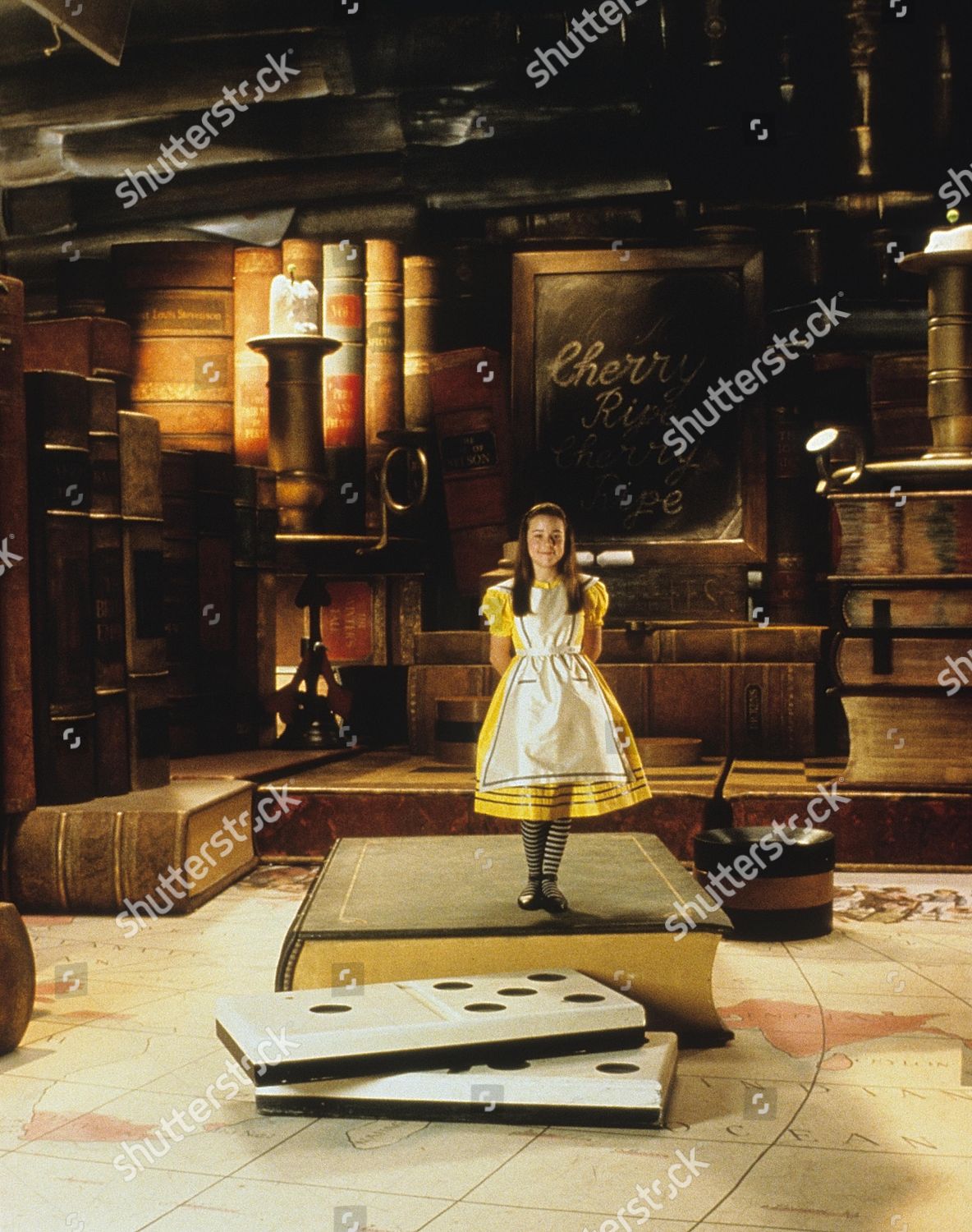
Alice In Wonderland - 1999

(Press photo by Shutterstock

1999 aired on NBC/Channel 4 20 years ago today! (this is according to IMDB... so actual dates may vary) 

Whilst it is by no means my favourite adaptation (its actually one of my least...) it is still an adaptation of Carroll's novels.

Something you can't say about the other 2 Alice films which followed in the 2010s (I'm still a bit bitter, sorry!) 

How To Survive 2017’s Flash Drought | StorageSwiss.com - The Home of Storage Switzerland

On a slightly sad note, we have officially entered adaptation drought territory... there has not been a film or TV version adapting Carroll's novels for 20 years (unless you count livestreams of the Chin opera or Wheeldon ballet)

Considering the only projects on the horizon are Come Away, Dorothy and Alice and potentially a Looking Glass Wars film, safe to say we might hit 25 years with no new adaptation quite safely....

Ugh!